Catholics believe that guardian angels serve God's care for us, helping us on the way to salvation. Devotion to them is an invitation to gratitude, prayer, and faithful living. It does not require discovering a secret name or interpreting ordinary events as coded messages.
The Memorial of the Holy Guardian Angels falls on October 2. If you remember a childhood guardian-angel prayer but are unsure what the Church actually teaches, this guide separates the foundations of that belief from speculation and offers a simple way to observe the day.
What does the Church teach about guardian angels?
The Catechism, paragraphs 328–336, describes angels as spiritual creatures who serve God. They have intelligence and will; they are not deceased human beings who have become angels. Christ remains the center of their life and mission.
Paragraph 336 describes angelic care and intercession throughout human life, from infancy to death, and cites Saint Basil's teaching about an angel accompanying each believer. Guardian-angel devotion therefore belongs to adult Christian life as well as childhood.
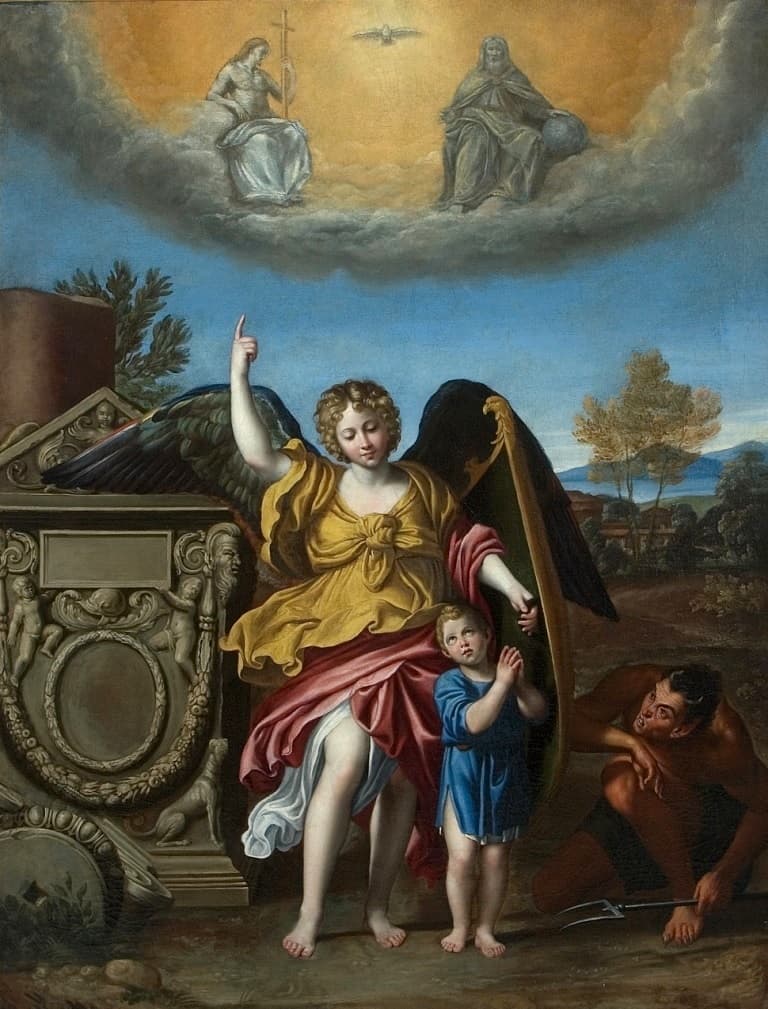
This is a teaching about God's help, not a detailed map of an invisible companion's daily activities. We can affirm the Church's teaching without claiming to know when a particular angel acted or what an angel looks like. The artwork used in this article is a devotional representation, not a portrait based on an observed encounter.
Why does the October 2 Gospel speak about children?
The memorial's Gospel is Matthew 18:1–5, 10. The disciples ask about greatness, and Jesus places a child before them. He teaches humility and receiving the small and vulnerable, then warns against despising the little ones while speaking of their angels before the Father. Read the passage in the USCCB's October 2 readings.
Keep that setting in view. The passage does not invite us to compete over extraordinary spiritual experiences. It directs our attention toward people we might overlook.
In his October 2, 2024 homily, Pope Francis connected the day's Gospel with humility, listening, and making room for others. His reflection was addressed to the Synod assembly, but its invitation to welcome rather than dominate offers a useful point for personal examination.
For example, a parent might pause before dismissing a child's question. A teacher could notice someone who rarely gets a turn to speak. A parish volunteer might help a newcomer find the right room instead of assuming everyone knows the routine. These are practical applications of the Gospel's concern for the small, not claims about how angels caused particular events.
Can Catholics pray to their guardian angels?
Yes. The Church recognizes devotion to the holy angels. The Directory on Popular Piety and the Liturgy, paragraphs 216–217, describes gratitude to God for angelic help and mentions the familiar Angele Dei prayer in family prayer.
Asking an angel's assistance is distinct from worshiping God. You can thank God for his care and ask your guardian angel to help you remain faithful to him. You do not need an unusual sensation or an audible answer for that prayer to be meaningful.
A practical place to begin is a brief pause before the day's responsibilities. Name a situation where you need patience or courage. Pray, then decide how you will act: prepare for a difficult conversation, speak truthfully, or ask someone for advice. For help making time consistently, see our daily prayer routine for busy Catholics.
Should you name your guardian angel?
The Directory, paragraph 217, discourages assigning names to angels, apart from Gabriel, Raphael, and Michael, whose names appear in Scripture. You can simply address your guardian angel as your guardian angel. A personally invented name is unnecessary for devotion.
The same paragraph cautions against simplistic explanations that attribute every success to angels and every setback to evil spirits. A fortunate coincidence does not require a supernatural explanation, and a difficult day does not reveal that you have been abandoned.
Our separate guide to Michael, Gabriel, and Raphael explains their biblical missions and September 29 feast. October 2 focuses on the holy guardian angels; the two celebrations are related but distinct.
Does angelic protection mean nothing bad will happen?
It should not be presented as a guarantee against accidents, illness, disappointment, or grief. Christian trust does not remove the need for ordinary precautions or responsible decisions.
For someone teaching children, that distinction matters. Avoid promising that prayer means they can never be hurt. Instead, connect prayer with sensible action: telling a trusted adult when something is wrong, following safety instructions, and accepting help. Adults can model that same combination of trust and responsibility.
If someone is suffering, an explanation about what their angel supposedly did or failed to do is unlikely to help. Begin by listening. Offer the practical support you can actually give without claiming to know God's reasons for the situation.
A simple way to observe October 2
Read the day's Gospel slowly, alone or with your family. Ask which person you have been tempted to overlook. Choose one modest act of attention for that person, such as listening without interruption or making time for a needed visit.
Then pray briefly in thanksgiving. If your parish offers Mass and you can attend, join its celebration. At the end of the day, recall one opportunity to act with greater care, without trying to assign unseen causes to everything that happened.
You can continue following the Church's calendar through Saint of the Day. A small observance can make the calendar part of daily life without adding a complicated project.
An original prayer for the day
This prayer was written for Saint Discovery; it is not the traditional Angele Dei text or an official liturgical prayer.
Father, thank you for the care you give through your holy angels. Help me welcome your guidance, listen with humility, and notice those who need kindness. Guardian angel, pray for me and help me follow Christ faithfully in the responsibilities of this day. Amen.
Cover artwork: Guardian Angel, attributed to the workshop of Domenichino, Palace Museum in Wilanów, Warsaw. Public-domain reproduction; see the artwork's source and licensing record.
