Catholic saint biography
St. Mariam Baouardy
- Commemoration:
- August 25
- Lived:
- 1846–1878 — I'billin, Galilee
Discalced Carmelite memorial; August 26 is her death anniversary and occurs in other calendars.
Why dates and liturgical observances can differ
Read the sources for this biography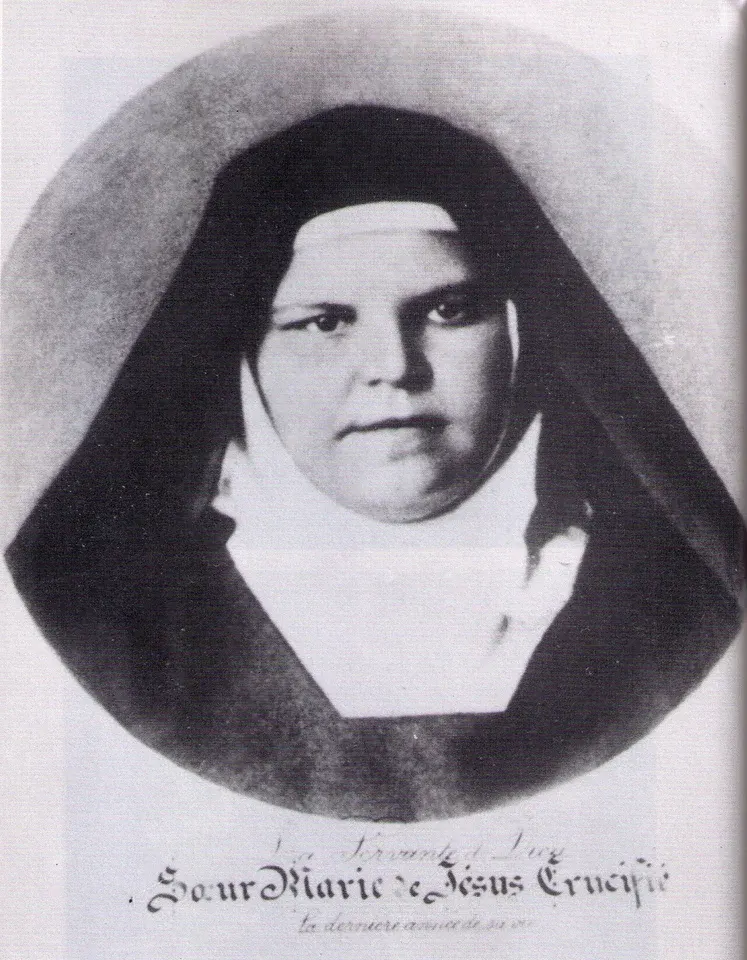
Biography
Mariam Baouardy was born into a Melkite Greek Catholic family in Galilee. Her life took her through several countries before she entered the Discalced Carmel at Pau in France in 1867, receiving the name Mary of Jesus Crucified. Her community remembered her for humble service and reported mystical experiences.
Both parents died while she was very young, and relatives raised her and her brother separately. Her later travels placed her in several linguistic and ecclesial settings. The Greek Catholic background of her childhood remained part of her identity even after she entered a French-speaking Carmelite community.
She participated in the Carmelite foundation at Mangalore in India and later returned to the Holy Land to help establish a monastery at Bethlehem. She died there in 1878. Canonized in 2015, she is honored within both her Middle Eastern Christian heritage and the Carmelite family. The Discalced Carmelite calendar assigns her memorial to August 25.
The foundations at Mangalore and Bethlehem gave her vocation an institutional legacy beyond reports of unusual prayer experiences. Those experiences should be identified as religious testimony rather than independently demonstrable phenomena. Her life also illustrates the connection between Eastern Catholic communities and the wider Carmelite tradition without erasing the differences between them.
Context & contribution
The collaborators behind Bethlehem Carmel
The Carmelite community's own history identifies a group undertaking behind the Bethlehem foundation. Ten Carmelites departed Pau in August 1875, accompanied by the benefactor Berthe Dartigaux. Mariam's role belonged within this collaboration of women who supplied the community, resources, and practical commitment needed to establish a permanent house.
The sisters remember Mariam as choosing its position on David's hill, facing the hill of the Nativity. Their account also connects the site's biblical associations with the community's prayer. This offers a way to study her legacy through an actual landscape and institution, alongside accounts of mystical experience: the foundation gave her attachment to the Holy Land a durable communal form.
Explore the sources for this section
AI-assisted source comparison updated 2026-09-26. Editorial approach
From the Saint Discovery blog
Keep exploring your faith
Practical guides to prayer, the saints, and living the Catholic faith.
Why Do Catholics Pray to Saints? Intercession Explained
Why do Catholics pray to saints? Learn how intercession differs from worship, how it relates to Jesus, and a simple way to ask a saint to pray for you.
A next step with your saintRead the article Living the seasonsHow to Celebrate Your Patron Saint's Feast Day at Home
Celebrate your patron saint's feast day with prayer, a short biography, and an act of kindness. A practical plan for families, sponsors, and individuals.
A next step with your saintRead the articleFrom reading to reflection
What will you carry with you?
After reading about St. Mariam Baouardy, take a moment to consider:
- Locate Bethlehem Carmel and the Nativity on a map, then list the distinct contributions of Mariam, her companions, and Berthe Dartigaux to the foundation.
These are reflection prompts from Saint Discovery, not quotations from the saint.
Sources and further reading
Biography source comparison recorded on . This is an AI-assisted comparison, not independent human or ecclesiastical approval.
What the recorded review covers
AI-assisted expansion of the existing source-reviewed biography with comparison to retrieved cited sources; not ecclesiastical approval
A source list helps you check an account; it does not establish that every claim is certain. Follow the biography’s qualifications about historical evidence, traditions and feast calendars.
Suggest a correction to this biography
How we research these pages and handle corrections · Directory corrections log
More lives to explore
Suggestions based on the site’s quiz themes, not a historical relationship or a measure of holiness.