Catholic saint biography
St. Kateri Tekakwitha
- Commemoration:
- July 14
- Lived:
- 1656–1680 — Mohawk territory, present-day New York
United States celebration July 14.
Why dates and liturgical observances can differ
Read the sources for this biography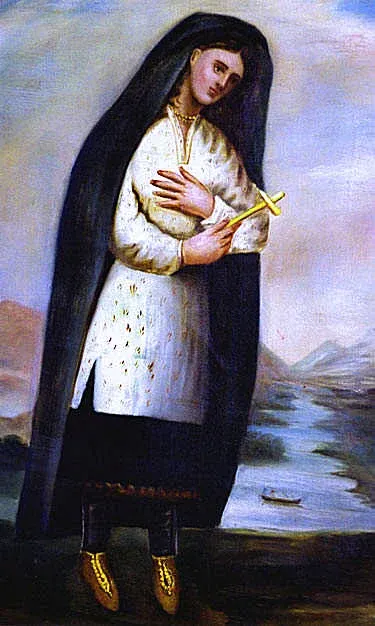
Biography
Kateri Tekakwitha was born to a Mohawk father and an Algonquin Christian mother. Smallpox killed her parents and brother and left her with impaired sight and facial scarring. Raised by relatives, she learned the practical skills of her community. She chose Christian baptism and resisted expectations that she marry, decisions that brought considerable tension within her surroundings.
The skills she learned included preparing food, making clothing, basketry, and agricultural work. Her Christian life grew within those daily responsibilities. At the settlement near Montreal, Indigenous Christian women played an important role in her formation; the community should not be described as though only European missionaries supported her.
In 1677 she moved to a Christian Indigenous settlement near Montreal. There she received guidance from other Native Christian women and pursued prayer, service, and a commitment to celibacy. Her short life should be understood within Indigenous history rather than as a rejection of Indigenous identity. She died in 1680; Catholic devotion remembers both her determined faith and the suffering she endured.
Her refusal of marriage and eventual commitment to celibacy made a particular personal vocation, not a judgment against family life. Accounts of extraordinary changes after her death belong to her devotional tradition. Her importance can be explained without relying on those reports: illness, displacement, community, and deliberate religious choices already define a distinctive life.
Context & contribution
The Native women in her Christian formation
Vatican News names Anastasia, a Christian Iroquois woman, as one of Kateri's guides after her arrival near Montreal. She taught prayer and penance and encouraged care for people in need. Naming this relationship gives substance to a part of the story easily lost when biographies focus only on missionaries and clergy.
The account also describes Kateri's penitential practices as shaped partly by Mohawk traditions. That observation requires care: her faith developed through cultural continuity as well as change. It is more accurate to examine particular relationships and practices than to frame her conversion as a complete replacement of one identity by another.
Explore the sources for this section
AI-assisted source comparison updated 2026-09-26. Editorial approach
From the Saint Discovery blog
Keep exploring your faith
Practical guides to prayer, the saints, and living the Catholic faith.
Why Do Catholics Pray to Saints? Intercession Explained
Why do Catholics pray to saints? Learn how intercession differs from worship, how it relates to Jesus, and a simple way to ask a saint to pray for you.
A next step with your saintRead the article Living the seasonsHow to Celebrate Your Patron Saint's Feast Day at Home
Celebrate your patron saint's feast day with prayer, a short biography, and an act of kindness. A practical plan for families, sponsors, and individuals.
A next step with your saintRead the articleFrom reading to reflection
What will you carry with you?
After reading about St. Kateri Tekakwitha, take a moment to consider:
- Rewrite a short account of Kateri's formation with Anastasia as a named participant; identify what becomes visible when Indigenous women are treated as teachers.
These are reflection prompts from Saint Discovery, not quotations from the saint.
Sources and further reading
Biography source comparison recorded on . This is an AI-assisted comparison, not independent human or ecclesiastical approval.
What the recorded review covers
AI-assisted expansion of the existing source-reviewed biography with comparison to retrieved cited sources; not ecclesiastical approval
A source list helps you check an account; it does not establish that every claim is certain. Follow the biography’s qualifications about historical evidence, traditions and feast calendars.
Suggest a correction to this biography
How we research these pages and handle corrections · Directory corrections log
More lives to explore
Suggestions based on the site’s quiz themes, not a historical relationship or a measure of holiness.