Catholic saint biography
St. John Ogilvie
- Commemoration:
- March 10
- Lived:
- About 1579/1580–1615 — Banffshire, Scotland
Scottish and Jesuit commemoration.
Why dates and liturgical observances can differ
Read the sources for this biography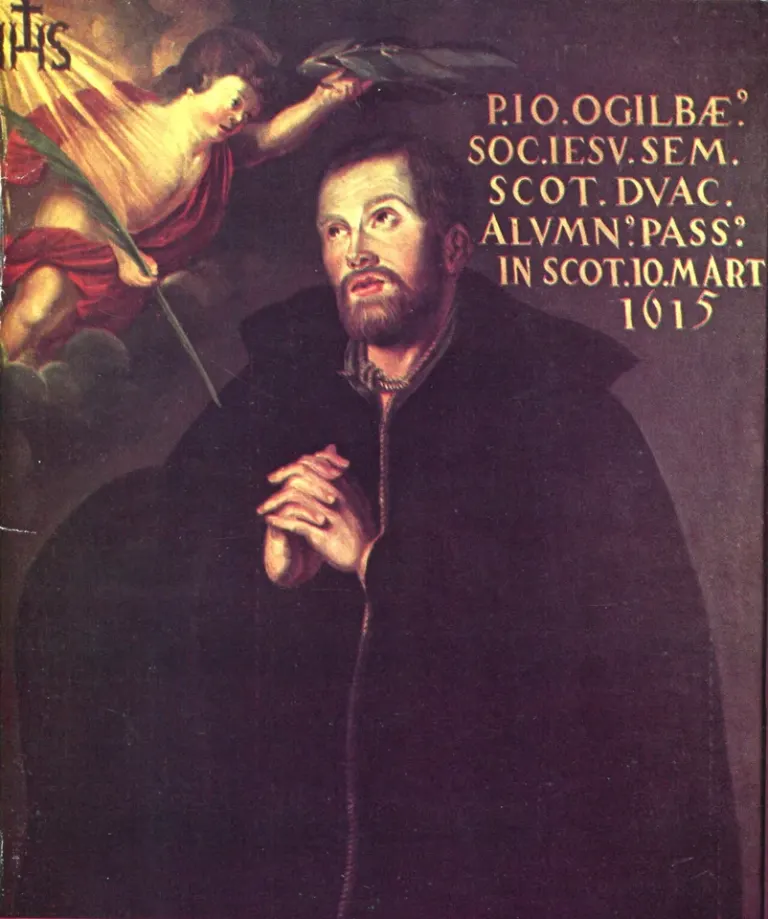
Biography
John Ogilvie was raised in a Protestant Scottish family and became Catholic while studying on the European continent. He entered the Jesuits and was ordained a priest in 1610. In 1613 he returned to Scotland under an assumed identity to minister to Catholics at a time when such ministry was prohibited.
His European education brought him into contact with different Christian confessions before he chose Catholicism. Jesuit formation then prepared him for a dangerous mission in his native country. Returning discreetly allowed him to celebrate the sacraments and sustain a community that could not practice openly in the same way as the established Church.
Arrested in Glasgow, he endured imprisonment and interrogation and refused to accept royal authority over religious belief in the terms demanded of him. He was convicted of treason and executed at Glasgow Cross on March 10, 1615. Paul VI canonized him in 1976. Accounts vary between 1579 and 1580 for his birth, so an approximate date is preferable.
The authorities treated his refusal as a political offense, whereas Catholic remembrance understands his death as witness to faith and conscience. Keeping both descriptions in view explains why he appears in histories of treason trials as well as accounts of martyrdom. His life was brief, and the evidence centers on his mission, captivity, and death.
Context & contribution
An international formation behind a Scottish mission
Ogilvie's route to Scotland passed through several European centers of Catholic education. He entered the Jesuit novitiate in Vienna, was ordained in Paris, and taught in Rouen before returning home. This geography matters: his short Scottish mission relied on a religious and educational network extending far beyond the community he hoped to serve.
The Jesuit historical account identifies his disguise as that of a horse dealer and says his body was placed in an unmarked grave. These details help explain the uneven shape of his memory. A clandestine ministry left fewer visible institutions than an open parish appointment, while later public commemoration preserved a name that the place of burial did not.
Explore the sources for this section
AI-assisted source comparison updated 2026-09-26. Editorial approach
From the Saint Discovery blog
Keep exploring your faith
Practical guides to prayer, the saints, and living the Catholic faith.
Why Do Catholics Pray to Saints? Intercession Explained
Why do Catholics pray to saints? Learn how intercession differs from worship, how it relates to Jesus, and a simple way to ask a saint to pray for you.
A next step with your saintRead the article Living the seasonsHow to Celebrate Your Patron Saint's Feast Day at Home
Celebrate your patron saint's feast day with prayer, a short biography, and an act of kindness. A practical plan for families, sponsors, and individuals.
A next step with your saintRead the articleFrom reading to reflection
What will you carry with you?
After reading about St. John Ogilvie, take a moment to consider:
- Plot Vienna, Paris, Rouen, and Glasgow on a map; discuss how an international educational network supported a mission that could not operate publicly.
These are reflection prompts from Saint Discovery, not quotations from the saint.
Sources and further reading
Biography source comparison recorded on . This is an AI-assisted comparison, not independent human or ecclesiastical approval.
What the recorded review covers
AI-assisted expansion of the existing source-reviewed biography with comparison to retrieved cited sources; not ecclesiastical approval
A source list helps you check an account; it does not establish that every claim is certain. Follow the biography’s qualifications about historical evidence, traditions and feast calendars.
Suggest a correction to this biography
How we research these pages and handle corrections · Directory corrections log
More lives to explore
Suggestions based on the site’s quiz themes, not a historical relationship or a measure of holiness.