Catholic saint biography
St. John Henry Newman
- Commemoration:
- October 9
- Lived:
- 1801–1890 — London, England
Universal Roman optional memorial established by decree dated November 9, 2025.
Why dates and liturgical observances can differ
Read the sources for this biography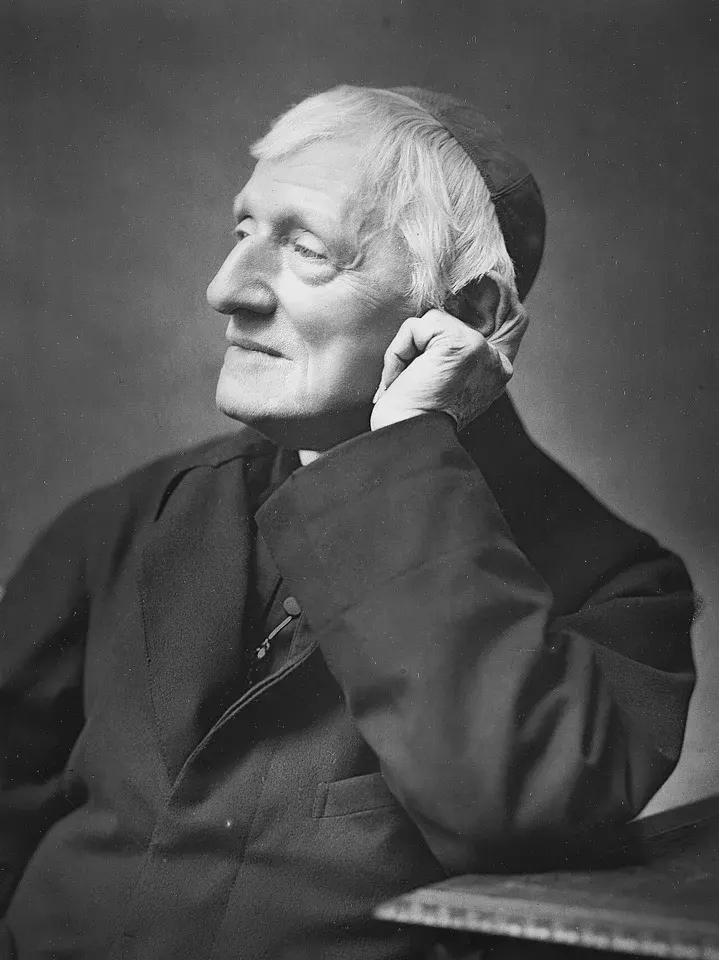
Biography
John Henry Newman was an Anglican priest and Oxford scholar who became a leading figure in the Oxford Movement. His study of early Christianity and doctrinal development contributed to his reception into the Catholic Church in 1845. Ordained a Catholic priest in 1847, he established the Birmingham Oratory the following year.
His movement at Oxford sought to recover the importance of the early Church, the sacraments, and apostolic tradition within Anglicanism. Becoming Catholic meant leaving the ecclesiastical and academic position around which much of his adult life had been organized. His conversion was the outcome of prolonged study rather than a sudden rejection of intellectual inquiry.
Newman's work encompassed preaching, theology, education, poetry, and pastoral care. He became a cardinal in 1879 and died in Birmingham in 1890. Pope Francis canonized him in 2019. In 2025 Pope Leo XIV proclaimed him a Doctor of the Church, and his October 9 celebration was subsequently inscribed as an optional memorial in the General Roman Calendar.
As an Oratorian, he joined a community of priests whose common life supported preaching and service without monastic vows. His enduring importance lies in bringing questions about belief, conscience, education, and historical continuity into conversation. His October feast recalls his reception into the Catholic Church rather than the anniversary of his death.
His Oxford ministry included parish work at Saint Clement's and preaching at the university church of Saint Mary the Virgin. Visiting sick and poor parishioners accompanied the scholarship for which he became better known. As a college tutor he also regarded students' moral formation as part of his responsibility. These roles help explain why questions about education and belief were practical pastoral concerns for him, not merely academic controversies.
After becoming Catholic, Newman continued that educational work as rector of the Catholic University of Ireland. His account of university education explored the relationship between different branches of knowledge and the formation of the mind. The Apologia Pro Vita Sua, written in response to an attack on his integrity, gave a public account of his religious development. His extensive writings preserve the reasoning and personal costs behind his changing convictions.
Context & contribution
Conviction, conscience, and public argument
Newman's Grammar of Assent explored how people reach firm convictions without reducing all reasoning to formal proofs. His later response to William Gladstone addressed a different public problem: the accusation that papal allegiance made Catholics unreliable citizens. These works show how his intellectual vocation extended beyond explaining his conversion.
The Birmingham Oratory's account also records unsuccessful projects, including a proposed Bible translation and an Oxford foundation. Reading these alongside his celebrated books makes his achievement more intelligible: influence emerged through controversy, revision, and frustrated plans. His defense of faith was sustained by argument even when institutional approval and practical success were uncertain.
Explore the sources for this section
AI-assisted source comparison updated 2026-09-26. Editorial approach
From the Saint Discovery blog
Keep exploring your faith
Practical guides to prayer, the saints, and living the Catholic faith.
What Saint John Henry Newman Teaches About Conscience
What does Saint John Henry Newman mean by conscience? Learn about truth, moral responsibility, conscience formation, and practical decisions.
Connected to this saintRead the article Prayer & reflectionWhy Do Catholics Pray to Saints? Intercession Explained
Why do Catholics pray to saints? Learn how intercession differs from worship, how it relates to Jesus, and a simple way to ask a saint to pray for you.
A next step with your saintRead the articleFrom reading to reflection
What will you carry with you?
After reading about St. John Henry Newman, take a moment to consider:
- Compare a conviction you can demonstrate formally with one reached through accumulated experience; use that distinction to frame a question for Newman's Grammar of Assent.
These are reflection prompts from Saint Discovery, not quotations from the saint.
Sources and further reading
- Holy See: 2019 canonization booklet, Newman biography ↗
- Holy See: Newman memorial decree, 2025 ↗
- Birmingham Oratory: Biography of Saint John Henry Newman ↗
Biography source comparison recorded on . This is an AI-assisted comparison, not independent human or ecclesiastical approval.
What the recorded review covers
AI-assisted expansion of the existing source-reviewed biography with comparison to retrieved cited sources; not ecclesiastical approval
A source list helps you check an account; it does not establish that every claim is certain. Follow the biography’s qualifications about historical evidence, traditions and feast calendars.
Suggest a correction to this biography
How we research these pages and handle corrections · Directory corrections log
More lives to explore
Suggestions based on the site’s quiz themes, not a historical relationship or a measure of holiness.