Catholic saint biography
St. Kuriakose Elias Chavara
- Commemoration:
- January 3
- Lived:
- 1805–1871 — Kainakary, Kerala, India
Dicastery commemoration January 3.
Why dates and liturgical observances can differ
Read the sources for this biography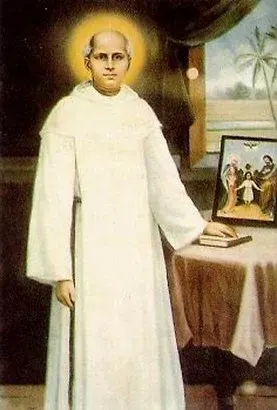
Biography
Kuriakose Elias Chavara was a priest of the Syro-Malabar Church in Kerala and a cofounder of the religious community now known as the Carmelites of Mary Immaculate. His work joined contemplative discipline to pastoral organization, the formation of clergy, and education. He helped establish durable institutions through which an Indian religious congregation could serve its own society.
He was born at Kainakary in 1805 and entered seminary formation while still young. The Syro-Malabar setting matters: his work grew within an ancient Indian Christian tradition, not simply as the local extension of a newly arrived European mission. Community formation and disciplined study helped give his initiatives continuity.
Chavara also promoted publishing, arranging a locally constructed printing press at Mannanam to make religious literature available. Education and communication were practical expressions of his concern for others, rather than separate from his prayer. He died in 1871 and was canonized by Pope Francis in 2014. His memory remains closely connected with Kerala's Catholic communities and their educational mission.
The press at Mannanam made the circulation of texts part of pastoral ministry. Schools and formation houses likewise turned concern for learning into institutions that could outlast one person's activity. His legacy is best understood by considering those initiatives together: prayer sustained the community, while education and publishing extended its service beyond the monastery.
Context & contribution
Religious foundations built through collaboration
Chavara's institutional work involved named collaborators: Thomas Palackal and Thomas Porukara in the men's foundation, and the Italian missionary Leopold Beccaro in the foundation of the Congregation of the Mother of Carmel. John Paul II's beatification homily explicitly recognized those relationships. They keep a founder's biography from implying that one person created an entire religious movement alone.
The women's congregation adds an important dimension to his legacy alongside the more frequently mentioned Carmelites of Mary Immaculate. Together these foundations gave local religious vocations enduring communal structures. Their significance lies both in the people who established them and in the Indian members who continued their work through subsequent generations.
Explore the sources for this section
AI-assisted source comparison updated 2026-09-26. Editorial approach
From the Saint Discovery blog
Keep exploring your faith
Practical guides to prayer, the saints, and living the Catholic faith.
What Is the Domestic Church? John Paul II on Faith at Home
What Catholics mean by the domestic church, how John Paul II explained family life, and practical ways to begin with prayer, forgiveness and welcome.
Bring reflection into prayerRead the article Prayer & reflectionHow to Make a Spiritual Communion When You Cannot Receive
Learn how to make a spiritual communion, with a short original prayer and clear guidance on Mass, Confession, and times when you cannot receive.
Bring reflection into prayerRead the articleFrom reading to reflection
What will you carry with you?
After reading about St. Kuriakose Elias Chavara, take a moment to consider:
- Make a collaboration chart naming Palackal, Porukara, Chavara, and Beccaro; distinguish a founder's leadership from the shared work needed for an enduring congregation.
These are reflection prompts from Saint Discovery, not quotations from the saint.
Sources and further reading
Biography source comparison recorded on . This is an AI-assisted comparison, not independent human or ecclesiastical approval.
What the recorded review covers
AI-assisted expansion of the existing source-reviewed biography with comparison to retrieved cited sources; not ecclesiastical approval
A source list helps you check an account; it does not establish that every claim is certain. Follow the biography’s qualifications about historical evidence, traditions and feast calendars.
Suggest a correction to this biography
How we research these pages and handle corrections · Directory corrections log
More lives to explore
Suggestions based on the site’s quiz themes, not a historical relationship or a measure of holiness.