Catholic saint biography
St. Isidore the Farmer
- Commemoration:
- May 15
- Patron Saint of:
- farmers
- Lived:
- Eleventh–twelfth centuries; exact dates disputed — Madrid, Spain
Traditional feast.
Why dates and liturgical observances can differ
Read the sources for this biography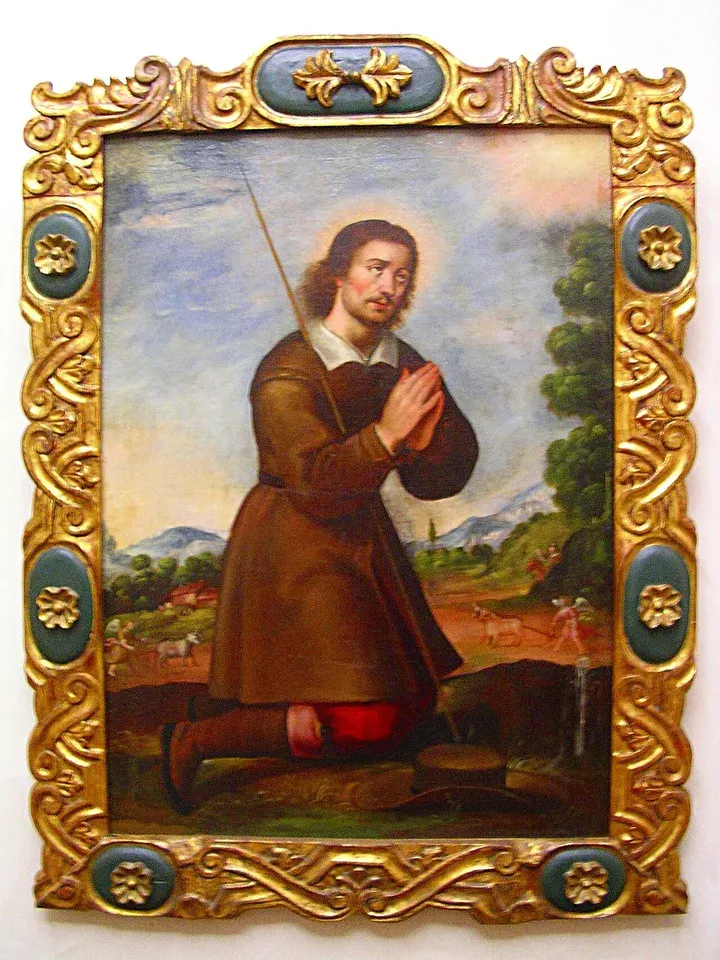
Biography
Saint Isidore the Farmer is remembered as a married agricultural laborer associated with Madrid. His veneration centers on prayer, ordinary work, and generosity rather than political office, scholarship, or the founding of a religious order.
Tradition places him in the service of a landowner and describes his wife, Maria, as sharing his faith. Accounts of their family and working life were written well after his death, so their detailed chronology cannot be treated as contemporary documentation.
The best-known stories tell of angels helping with the plowing while Isidore prayed, and of rising water rescuing the couple's child from a well. These are devotional narratives expressing divine care and the harmony of prayer with labor; they should be distinguished from independently verified events.
His cult became deeply rooted in Madrid and in farming communities. Gregory XV canonized him in 1622 alongside Ignatius of Loyola, Francis Xavier, Teresa of Jesus, and Philip Neri. That company highlights the breadth of Catholic models of holiness: a laborer's daily responsibilities could stand beside the achievements of celebrated founders. His patronage remains especially associated with farmers and agricultural workers.
Context & contribution
From a parish life to a literary afterlife
The Catholic Encyclopedia identifies an important stage in Isidore's written tradition: a life composed in 1265 and supplemented in 1275 by John, a deacon of Madrid's church of Saint Andrew. Giving the writer and dates makes the distance from Isidore's lifetime concrete, rather than leaving the reader with an unspecified appeal to tradition.
That medieval life later supplied material for Lope de Vega's religious poem San Isidro, published in 1599. The movement from parish remembrance to a major literary work helps explain the laborer's wider cultural presence. It also requires care: a poet's elaboration may be valuable evidence for devotion and imagination without adding independent testimony about twelfth-century events.
Explore the sources for this section
AI-assisted source comparison updated 2026-09-26. Editorial approach
From the Saint Discovery blog
Keep exploring your faith
Practical guides to prayer, the saints, and living the Catholic faith.
What Is the Domestic Church? John Paul II on Faith at Home
What Catholics mean by the domestic church, how John Paul II explained family life, and practical ways to begin with prayer, forgiveness and welcome.
Bring reflection into prayerRead the article Prayer & reflectionHow to Make a Spiritual Communion When You Cannot Receive
Learn how to make a spiritual communion, with a short original prayer and clear guidance on Mass, Confession, and times when you cannot receive.
Bring reflection into prayerRead the articleFrom reading to reflection
What will you carry with you?
After reading about St. Isidore the Farmer, take a moment to consider:
- Compare the dates of Isidore's life, the deacon John's account, and Lope de Vega's poem. Explain how the same story serves different audiences at each stage.
These are reflection prompts from Saint Discovery, not quotations from the saint.
Sources and further reading
Biography source comparison recorded on . This is an AI-assisted comparison, not independent human or ecclesiastical approval.
What the recorded review covers
AI-assisted expansion checked against cited sources; historical traditions distinguished from documented evidence; not ecclesiastical approval
A source list helps you check an account; it does not establish that every claim is certain. Follow the biography’s qualifications about historical evidence, traditions and feast calendars.
Suggest a correction to this biography
How we research these pages and handle corrections · Directory corrections log
More lives to explore
Suggestions based on the site’s quiz themes, not a historical relationship or a measure of holiness.