Catholic saint biography
St. Cosmas
- Commemoration:
- September 26
- Lived:
- Traditionally third century — Eastern Mediterranean, traditionally Syria and Cilicia
Roman commemoration with Damian; Eastern calendars distinguish multiple pairs.
Why dates and liturgical observances can differ
Read the sources for this biography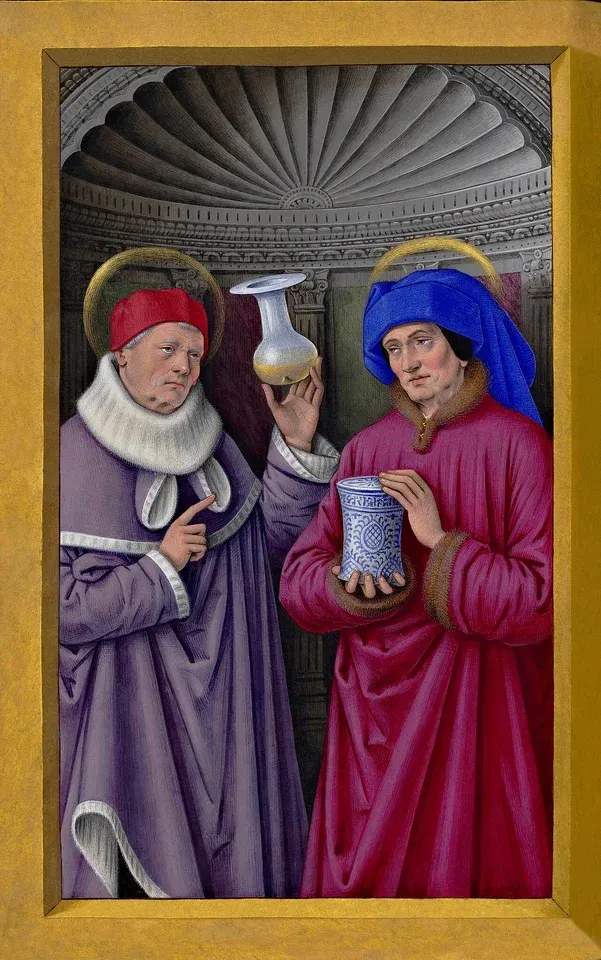
Biography
Cosmas is venerated with Damian as one of the Christian physicians who treated sick people without demanding payment. Their traditional title, the unmercenary physicians, expresses this association of medical care with charity. Christian memory places their martyrdom in the era of Roman persecution, but the detailed accounts developed long after their deaths.
The Greek title associated with the brothers means physicians without silver: healers who did not charge for their services. In their traditional portrait, care for bodily illness accompanies concern for the patient’s spiritual life. This explains their enduring association with medicine and charitable treatment.
Their stories reached later Christians through texts such as the Golden Legend and through religious art. Such works reveal how communities understood the brothers’ sanctity, but they do not supply contemporary clinical records or a securely recoverable sequence of their final days.
Stories of miraculous escapes from torture and even a speaking animal at their burial belong to legendary hagiography. They should not be presented as independently documented events. Their cult spread from the East to Rome, where a basilica bears their names. The Roman calendar remembers the pair on September 26; Eastern traditions preserve several distinct commemorations of saints bearing these names.
Context & contribution
The physician martyrs in Rome's ancient civic center
The Roman basilica of Cosmas and Damian incorporates earlier public buildings, including part of the Forum of Peace complex and the rotunda commonly called the Temple of Romulus. Pope Felix IV adapted the site for Christian worship in the sixth century. The building makes the brothers' reception visible within the transformation of Rome's civic landscape.
Its apse mosaic places Cosmas and Damian in the company of Peter and Paul around Christ, with Felix carrying a model of the church. This is a visual statement of belonging and patronage, rather than an illustrated medical biography. Studying the architecture and mosaic reveals how Rome adopted the memory of the eastern physician martyrs and expressed it through a prominent shared place of worship.
Explore the sources for this section
AI-assisted source comparison updated 2026-09-26. Editorial approach
From the Saint Discovery blog
Keep exploring your faith
Practical guides to prayer, the saints, and living the Catholic faith.
St. Josephine Bakhita: Hope Without Denying Suffering
Learn what St. Josephine Bakhita teaches about Christian hope, dignity, and freedom, with practical reflection prompts and an original prayer.
Faith in difficult timesRead the article Prayer & reflectionWhat Is Redemptive Suffering? A Catholic Guide
What is redemptive suffering? Learn what Catholics mean by offering it up, how to unite suffering to Christ, and why seeking help belongs with faith.
Faith in difficult timesRead the articleFrom reading to reflection
What will you carry with you?
After reading about St. Cosmas, take a moment to consider:
- Examine the basilica's apse mosaic and explain what is communicated by placing Cosmas and Damian beside Peter and Paul.
These are reflection prompts from Saint Discovery, not quotations from the saint.
Sources and further reading
Biography source comparison recorded on . This is an AI-assisted comparison, not independent human or ecclesiastical approval.
What the recorded review covers
AI-assisted expansion checked against retrieved historical and institutional sources; traditions distinguished from documented history; not ecclesiastical approval
A source list helps you check an account; it does not establish that every claim is certain. Follow the biography’s qualifications about historical evidence, traditions and feast calendars.
Suggest a correction to this biography
How we research these pages and handle corrections · Directory corrections log
More lives to explore
Suggestions based on the site’s quiz themes, not a historical relationship or a measure of holiness.