Catholic saint biography
St. Dominic de Guzmán
- Commemoration:
- August 8
- Lived:
- About 1170–1221 — Caleruega, Spain
August 8 in the current Roman calendar; August 4 in older Roman calendars.
Why dates and liturgical observances can differ
Read the sources for this biography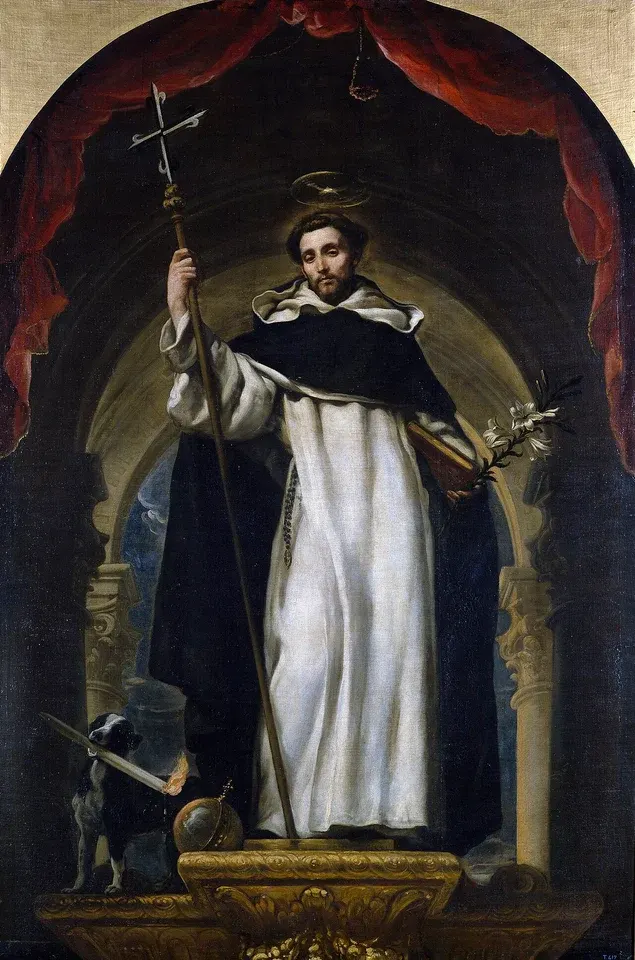
Biography
Dominic de Guzmán founded the Order of Preachers, the Dominicans, to unite religious community, learning, and public preaching. Born at Caleruega in Spain around 1170, he became a priest and a canon at Osma.
Travel with his bishop, Diego, brought him into contact with religious divisions in southern France. Their original hopes for missionary work elsewhere gave way to sustained engagement with Cathar communities. Dominic came to believe that preachers needed a credible life of poverty as well as the ability to explain Christian teaching.
After Diego's death, he continued preaching and disputation. The order received papal approval in 1216. Dominic sent companions to centers of study, linking theological education with a mobile ministry rather than confining every friar to one locality.
He died in Bologna in 1221 and was canonized in 1234. His legacy includes an international religious family committed to study and preaching. Accounts of later inquisitorial institutions should not simply be projected backward onto his personal career. Likewise, popular stories about his receiving the rosary require distinction from the documentary history of the order and the gradual development of that devotion.
Context & contribution
Women and the beginnings at Prouille
The community established at Prouille in 1206 belongs near the beginning of Dominic's institutional work. It provided religious life for women in a region divided over belief, including women leaving Cathar circles. The history of his mission therefore includes a settled women's community before the worldwide expansion of the friars.
His later foundations near Paris and Bologna also involved practical decisions about teachers, buildings, and access to learning. At Paris, Michael de Fabra was assigned responsibility for studies. These details show how a commitment to preaching became an educational organization: a persuasive speaker's personal gifts had to be made available to successors.
Explore the sources for this section
AI-assisted source comparison updated 2026-09-26. Editorial approach
From the Saint Discovery blog
Keep exploring your faith
Practical guides to prayer, the saints, and living the Catholic faith.
Why Is St. Thérèse the Patron Saint of Missions?
Why is St. Thérèse patron saint of missions? Discover her support for missionaries and practical ways to participate in the Church's mission from home.
Sharing the faithRead the article Everyday faithWhat Is Evangelization? A Catholic Guide to Sharing the Faith
What is evangelization? Learn the Catholic meaning, the new evangelization, and practical ways to share your faith with respect, confidence, and love.
Sharing the faithRead the articleFrom reading to reflection
What will you carry with you?
After reading about St. Dominic de Guzmán, take a moment to consider:
- Place Prouille, Paris, and Bologna on a map, then identify the different need each foundation met in Dominic's developing mission.
These are reflection prompts from Saint Discovery, not quotations from the saint.
Sources and further reading
Biography source comparison recorded on . This is an AI-assisted comparison, not independent human or ecclesiastical approval.
What the recorded review covers
AI-assisted expansion checked against cited sources; historical traditions distinguished from documented evidence; not ecclesiastical approval
A source list helps you check an account; it does not establish that every claim is certain. Follow the biography’s qualifications about historical evidence, traditions and feast calendars.
Suggest a correction to this biography
How we research these pages and handle corrections · Directory corrections log
More lives to explore
Suggestions based on the site’s quiz themes, not a historical relationship or a measure of holiness.