Catholic saint biography
St. Dismas, the Good Thief
- Commemoration:
- March 25
- Lived:
- First century — Judea
Traditional local Western commemoration.
Why dates and liturgical observances can differ
Read the sources for this biography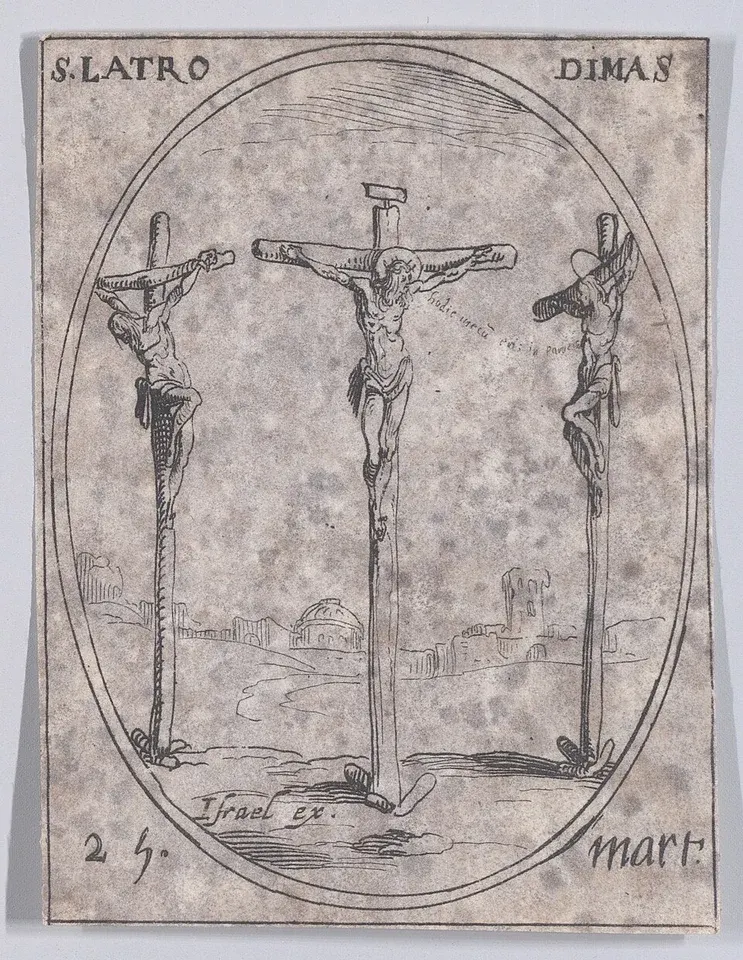
Biography
Dismas is the traditional name of the repentant criminal crucified beside Jesus. His significance comes from the encounter in Luke 23:39–43, where he acknowledges his wrongdoing and receives Jesus' promise of paradise.
Luke places two condemned men beside Jesus. While one challenges Jesus to save himself and them, the other rebukes him. He distinguishes their punishment from Jesus' innocence and asks Jesus to remember him when he comes into his kingdom.
The scene gives an unusually direct portrait of repentance: the man does not deny responsibility, demand release, or claim a record of achievement. His appeal is directed to Jesus, whose answer promises a relationship extending beyond the death they face.
The Gospel supplies neither his name nor a history of his crimes, family, or conversion before this encounter. Dismas and stories linking him with Jesus' childhood belong to later Christian tradition. They should not be read as missing details supplied by Luke. His traditional March 25 remembrance centers on mercy and hope at the end of life, rather than on a fully documented personal biography.
Context & contribution
A promise rather than a formal process
Calling Dismas the first canonized saint is a devotional way of emphasizing Jesus' promise to him. It should not be understood as an early instance of the later Church procedure for investigating a cause. The expression makes a theological claim about Christ's mercy, not an institutional claim about a tribunal.
Nominis also retells a childhood encounter between Dismas and the Holy Family, explicitly as legend. Its repayment motif imagines a connection between earlier kindness and mercy at death. Studying that motif can illuminate popular devotion, provided the imagined backstory remains distinct from the Gospel encounter.
Explore the sources for this section
AI-assisted source comparison updated 2026-09-26. Editorial approach
From the Saint Discovery blog
Keep exploring your faith
Practical guides to prayer, the saints, and living the Catholic faith.
Why Do Catholics Pray to Saints? Intercession Explained
Why do Catholics pray to saints? Learn how intercession differs from worship, how it relates to Jesus, and a simple way to ask a saint to pray for you.
A next step with your saintRead the article Living the seasonsHow to Celebrate Your Patron Saint's Feast Day at Home
Celebrate your patron saint's feast day with prayer, a short biography, and an act of kindness. A practical plan for families, sponsors, and individuals.
A next step with your saintRead the articleFrom reading to reflection
What will you carry with you?
After reading about St. Dismas, the Good Thief, take a moment to consider:
- Explain to a younger reader why 'first canonized saint' means something different for Dismas than for a saint canonized by a modern pope.
These are reflection prompts from Saint Discovery, not quotations from the saint.
Sources and further reading
Biography source comparison recorded on . This is an AI-assisted comparison, not independent human or ecclesiastical approval.
What the recorded review covers
AI-assisted expansion checked against cited sources; historical traditions distinguished from documented evidence; not ecclesiastical approval
A source list helps you check an account; it does not establish that every claim is certain. Follow the biography’s qualifications about historical evidence, traditions and feast calendars.
Suggest a correction to this biography
How we research these pages and handle corrections · Directory corrections log
More lives to explore
Suggestions based on the site’s quiz themes, not a historical relationship or a measure of holiness.