Catholic saint biography
St. Cyril and Methodius
- Commemoration:
- February 14
- Patron Saint of:
- Europe
- Lived:
- Cyril about 827–869; Methodius about 815–885 — Thessalonica, Byzantine Empire
February 14 in the Roman calendar; other traditions observe different joint and individual dates.
Why dates and liturgical observances can differ
Read the sources for this biography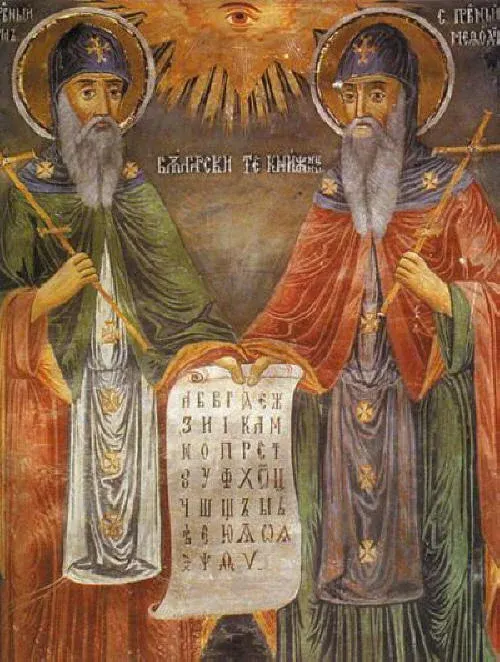
Biography
Cyril and Methodius were brothers from Thessalonica who brought Christian teaching and worship to Slavic-speaking peoples. Their mission to Great Moravia involved translating Scripture and liturgical texts into Slavonic. Cyril devised the Glagolitic script to serve that work; the later Cyrillic alphabet developed among their successors.
The brothers came from Thessalonica and brought different experience to their shared mission. Cyril, originally Constantine, received an advanced education in Constantinople; Methodius had administrative experience before becoming a monk. An earlier embassy to the Khazars also exposed them to religious discussion beyond the Byzantine Christian world.
Their Moravian work answered a request for teachers able to explain Christianity in the people’s own language. Cyril developed the Glagolitic alphabet to support translation; the later Cyrillic alphabet should not simply be treated as his personal invention. Their achievements involved language, education, worship, and contested church authority together.
Their use of a local language met resistance from clergy who defended established Latin practice. They sought support in Rome, where Cyril became a monk and died in 869. Methodius returned to the mission as a bishop and continued despite imprisonment and political opposition. Their legacy links evangelization with translation and cultural understanding. They are Catholic co-patrons of Europe.
Context & contribution
The disciples who carried the translation project forward
The brothers' work survived through a network of disciples. After Methodius died in 885, some followers were imprisoned or sold into slavery; Benedict XVI's account describes captives being redeemed in Venice and disciples finding welcome in Bulgaria. The mission's continuation depended on these often less familiar people as well as on its two principal figures.
The translated corpus also extended beyond passages used in worship. The papal account names biblical texts, a collection of church law called the Nomocanon, and patristic material associated with Methodius and his collaborators. Translation was therefore part of building a church's capacity to teach, govern, and remember. Its influence traveled with communities displaced from the original Moravian mission.
Explore the sources for this section
AI-assisted source comparison updated 2026-09-26. Editorial approach
From the Saint Discovery blog
Keep exploring your faith
Practical guides to prayer, the saints, and living the Catholic faith.
Why Is Saint Luke's Symbol an Ox? Meaning and Biblical Roots
Discover why Saint Luke's symbol is a winged ox, its biblical roots, and how the image connects his Gospel with priesthood and sacrifice.
Go deeper into ScriptureRead the article Prayer & reflectionHow to Pray the Jesus Prayer: A Catholic Beginner's Guide
Learn the Jesus Prayer, its Eastern Christian roots and biblical meaning, with a simple Catholic practice focused on Christ and mercy.
Go deeper into ScriptureRead the articleFrom reading to reflection
What will you carry with you?
After reading about St. Cyril and Methodius, take a moment to consider:
- Imagine planning the disciples' next library after displacement: why would Scripture, church law, and earlier Christian teachers all be needed?
These are reflection prompts from Saint Discovery, not quotations from the saint.
Sources and further reading
Biography source comparison recorded on . This is an AI-assisted comparison, not independent human or ecclesiastical approval.
What the recorded review covers
AI-assisted expansion checked against retrieved historical and institutional sources; traditions distinguished from documented history; not ecclesiastical approval
A source list helps you check an account; it does not establish that every claim is certain. Follow the biography’s qualifications about historical evidence, traditions and feast calendars.
Suggest a correction to this biography
How we research these pages and handle corrections · Directory corrections log
More lives to explore
Suggestions based on the site’s quiz themes, not a historical relationship or a measure of holiness.