Catholic saint biography
St. Adrian of Nicomedia
- Commemoration:
- September 8
- Lived:
- Died about 306 — Nicomedia
Why dates and liturgical observances can differ
Read the sources for this biography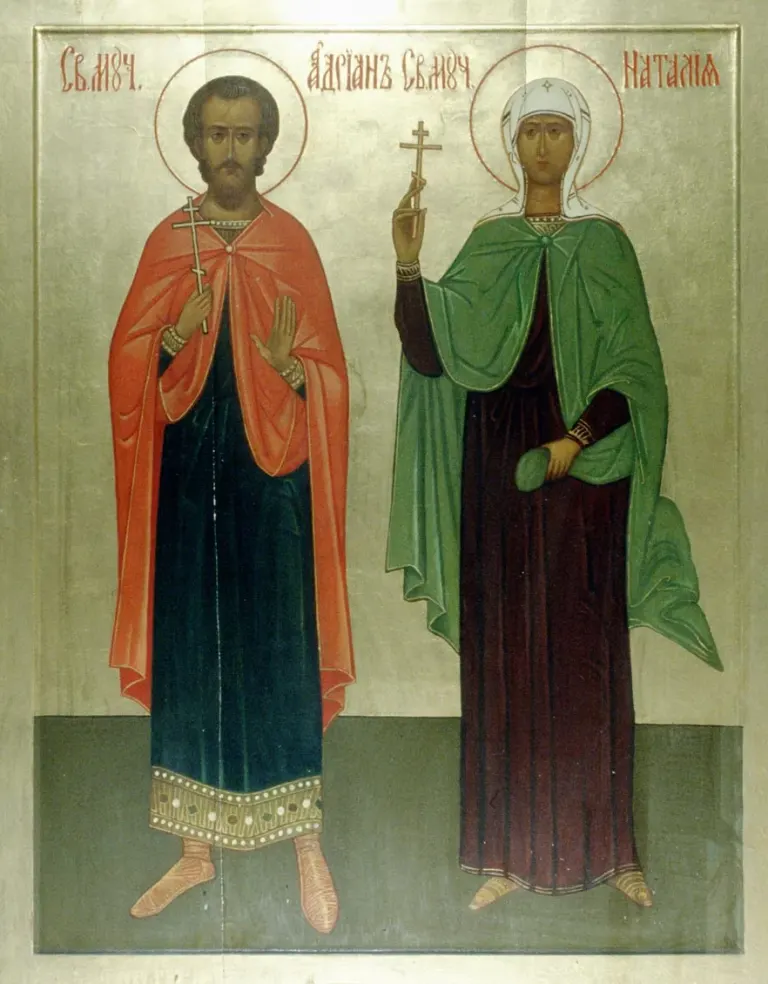
Biography
Adrian, also called Hadrian, is an early Christian martyr associated with Nicomedia. His veneration is ancient, but the detailed accounts of his conversion and suffering survive in legendary narratives rather than contemporary trial records.
According to that tradition, Adrian served as an imperial officer and witnessed the interrogation of a group of Christians. Their courage moved him to declare himself Christian. He was then imprisoned with the people whose treatment he had observed. His wife Natalia, already a Christian in the story, encouraged him and cared for the prisoners.
The narratives describe his execution and Natalia's preservation of his remains. Their dialogue, elaborate punishments, and miraculous episodes must be read as elements of a martyr's passion, not securely verified reporting. The Catholic Encyclopedia explicitly identifies these limitations.
Devotion spread to Constantinople and Rome, where a church in the Roman Forum bore his name. September 8 commemorates the translation of his relics in Roman tradition; August 26 appears in Eastern calendars. These different observances and the spellings Adrian and Hadrian do not require two separate saints. His enduring story centers on conversion through another person's witness and fidelity shared within marriage.
Context & contribution
How a martyr's memory crossed regions
Adrian's veneration links Nicomedia, Constantinople, and Rome. This geographical spread is a contribution of his cult to Christian memory, even where the detailed story of his life remains uncertain. The movement of relics and dedication of a Roman church helped a martyr associated with the eastern empire become familiar in the Latin West.
A translation feast commemorates the relocation of relics, not necessarily a death. That distinction explains why September 8 need not compete with another date attached to his martyrdom. His story is also preserved in Greek and Latin versions, reminding readers that differences between narratives can result from transmission rather than evidence for additional people.
Explore the sources for this section
AI-assisted source comparison updated 2026-09-26. Editorial approach
From the Saint Discovery blog
Keep exploring your faith
Practical guides to prayer, the saints, and living the Catholic faith.
St. Josephine Bakhita: Hope Without Denying Suffering
Learn what St. Josephine Bakhita teaches about Christian hope, dignity, and freedom, with practical reflection prompts and an original prayer.
Faith in difficult timesRead the article Prayer & reflectionWhat Is Redemptive Suffering? A Catholic Guide
What is redemptive suffering? Learn what Catholics mean by offering it up, how to unite suffering to Christ, and why seeking help belongs with faith.
Faith in difficult timesRead the articleFrom reading to reflection
What will you carry with you?
After reading about St. Adrian of Nicomedia, take a moment to consider:
- Mark Nicomedia, Constantinople, and Rome on a map. How does following a cult's movement differ from reconstructing the person's own travels?
These are reflection prompts from Saint Discovery, not quotations from the saint.
Sources and further reading
Biography source comparison recorded on . This is an AI-assisted comparison, not independent human or ecclesiastical approval.
What the recorded review covers
AI-assisted expansion checked against retrieved historical and institutional sources; traditions distinguished from documented history; not ecclesiastical approval
A source list helps you check an account; it does not establish that every claim is certain. Follow the biography’s qualifications about historical evidence, traditions and feast calendars.
Suggest a correction to this biography
How we research these pages and handle corrections · Directory corrections log
More lives to explore
Suggestions based on the site’s quiz themes, not a historical relationship or a measure of holiness.