Updated September 26, 2026
More people are preparing to become Catholic in some dioceses, and young adults are an important part of the story. France's baptism figures, Boston's larger catechumen group, and a new American OCIA survey offer evidence worth examining. They also help explain why a single headline about a worldwide “Gen Z revival” cannot tell the whole story.
For someone watching friends explore Catholicism, or considering it themselves, the useful questions are personal as well as statistical: What are people seeking? What does joining involve? And where can you begin without pretending to have every answer?
Are more young people becoming Catholic? What the numbers show
France: adult baptisms are increasing, with a younger profile
The French bishops' conference reported 13,234 adults preparing for baptism at Easter 2026, a 28% increase over 2025. Its annual overview also explains that the 18–25 age group has overtaken the 26–40 group among adult catechumens. These are figures for people seeking baptism, not a count of every young Catholic or everyone attending Mass. Source: Catholic Church in France, 2026 baptism survey overview.
That distinction strengthens the story: the evidence identifies a particular kind of growth rather than requiring a claim about an entire country's religious identity. Because the source was issued before Easter, its figures describe planned baptisms, not a subsequent attendance audit.
Boston: a larger group preparing for baptism
The Archdiocese of Boston's newspaper, The Pilot, reported more than 680 catechumens at the February 2026 Rite of Election, compared with 450 in 2025 and a typical range of 250–300 in earlier years. Parishes and campus ministries represented increased from 86 to 112. The report includes the experience of a 19-year-old preparing for baptism, but the total is not an age-specific count. Source: The Pilot, February 27, 2026.
These numbers show a local increase in a defined group. They should not be relabeled as a national increase in Gen Z conversions, or as completed baptisms simply because participants had reached the Rite of Election.
Why are young adults exploring Catholicism?
A June 2026 study coordinated by the Archdiocese of Chicago surveyed 2,127 OCIA participants across 20 U.S. dioceses. Respondents frequently identified spiritual growth, truth, peace, liturgy, and tradition as reasons for exploring Catholicism. Read the OCIA study.
Among its Gen Z respondents, 81% strongly considered growing in goodness and virtue, 80% a deeper understanding of truth, and 72% the Church's liturgy. These responses could overlap; they are not exclusive explanations or percentages of all young Americans. The sample also included existing Catholics completing their sacraments, so it should not be described simply as a survey of new converts.
The findings suggest several useful starting points for conversation. Ask what a person hopes to understand about God, what they have encountered at Mass, or which questions they have been carrying. Listen before deciding that their interest must be political, aesthetic, or the result of a particular social-media personality.
Relationships can open a door
The Boston report includes people whose journeys involved a grandmother, a fiancé, or other personal connections. Such accounts illustrate how an invitation can matter, without establishing one universal explanation for conversion. A friend's willingness to answer an awkward question may be more helpful than an argument about whether an entire generation is becoming religious.
Questions about worship deserve real answers
Someone attracted to Mass may still wonder why Catholics believe in the Eucharist, honor Mary, or ask saints for their prayers. Curiosity and conviction do not always arrive together. Our explainers on Eucharistic miracles and the Real Presence and why Catholics pray to saints can help begin those conversations.
Does this mean the Catholic Church is growing everywhere?
No. Local increases and a nationwide religious trend measure different things. Pew Research Center's June 2026 summary reports that converts account for 1.5% of U.S. adults, or about 8% of American Catholics. Its analysis also finds more than eight people who left their childhood Catholic identity for every person who became Catholic after being raised differently. Source: Pew Research Center.
Those switching figures primarily draw on the 2023–24 Religious Landscape Study. They compare childhood religion with current identity, rather than counting arrivals and departures during 2026. They therefore neither measure this year's Easter intake nor erase the increases reported by individual dioceses.
Both findings can be true: particular parishes can welcome more newcomers while the broader Church still faces substantial losses and challenges in retaining members. Following the trend responsibly means watching sustained participation as well as entry numbers.
Is this mainly a movement of young men?
The Chicago study's full respondent group was 54% female and 46% male. That is an all-age sample, not a national Gen Z gender breakdown. It cautions against assuming the same pattern in every place. Source: 2026 OCIA study.
What is OCIA, and how do you join?
OCIA stands for the Order of Christian Initiation of Adults. Many people still recognize the older name, RCIA. It involves learning, prayer, discernment, and participation in parish life, with preparation appropriate to a person's background. The USCCB's introduction to Christian initiation explains the journey and its stages.
Not everyone arriving at a parish needs the same preparation. An unbaptized person preparing for initiation is a catechumen. A validly baptized Christian seeking full communion is already baptized and is not baptized again. A baptized Catholic completing Confirmation or first Communion is not a new convert simply because they take part in formation. The USCCB explains these distinct groups.
Contact a local Catholic parish and ask to speak with the OCIA coordinator. Explain whether you have been baptized and what you hope to learn. If you are in the Justin or Fort Worth area, the Diocese of Fort Worth's OCIA resources are a useful local starting point. Ask the parish about its schedule rather than assuming every community begins in the same month.
How to compare conversion headlines fairly
Before comparing two numbers, check four things: who was counted, where they lived, the period covered, and the stage they had reached. A registration, attendance at the Rite of Election, reception into full communion, and a baptism are different events. An age range such as 18–25 is also not interchangeable with every definition of Gen Z.
Here is a hypothetical illustration, not new research: a parish moving from ten catechumens to twenty has doubled its group, while another moving from one hundred to one hundred twenty has welcomed more additional people despite a smaller percentage increase. Both the starting number and the percentage help readers understand the change. Neither tells us whether those people remain active a year later.
For the same reason, a survey of people already participating in OCIA can describe their reported motivations, but it cannot tell us how common those motivations are among all young adults. Preserve that distinction when discussing the Chicago study. The evidence can help a parish listen more carefully without becoming a prediction about everyone outside its doors.
What should a newcomer expect after the first invitation?
Offer a named contact and a specific next opportunity to talk. A helpful original invitation might be: “You can come with me on Sunday, and afterward I can introduce you to someone who answers questions about becoming Catholic.” Leave room for the person to decline or take more time.
Afterward, ask what was clear and what was confusing. Someone impressed by church architecture may still need an explanation of the Eucharist; someone persuaded by an argument may still need friendship. For preparation timelines and the different paths for baptized and unbaptized people, read why becoming Catholic can take time. Interest becomes easier to explore when the next step is understandable and personal.
How can a parish welcome someone who is interested?
A practical welcome can be simple: introduce yourself, offer to sit together at Mass, and make room for questions without turning each conversation into a test. Explain where to find the parish office, whom to ask about formation, and how to get involved beyond attending a class.
Keep that welcome going after someone receives the sacraments. Invite them to a meal, a service project, or a regular parish group. The person who once needed directions to an inquiry meeting may later need friendship and encouragement just as much.
If you are exploring the faith yourself, begin with one next step. Read about a saint whose questions or experiences interest you, try a simple daily prayer routine, or arrange a conversation at a nearby parish. When choosing a patron saint becomes part of your preparation, our Confirmation saint selection guide can help you explore thoughtfully.
Sources and artwork
This article distinguishes pre-Easter counts, an OCIA participant survey, and population research because they answer different questions. Figures are attributed and dated above; none is presented as a worldwide count of young converts.
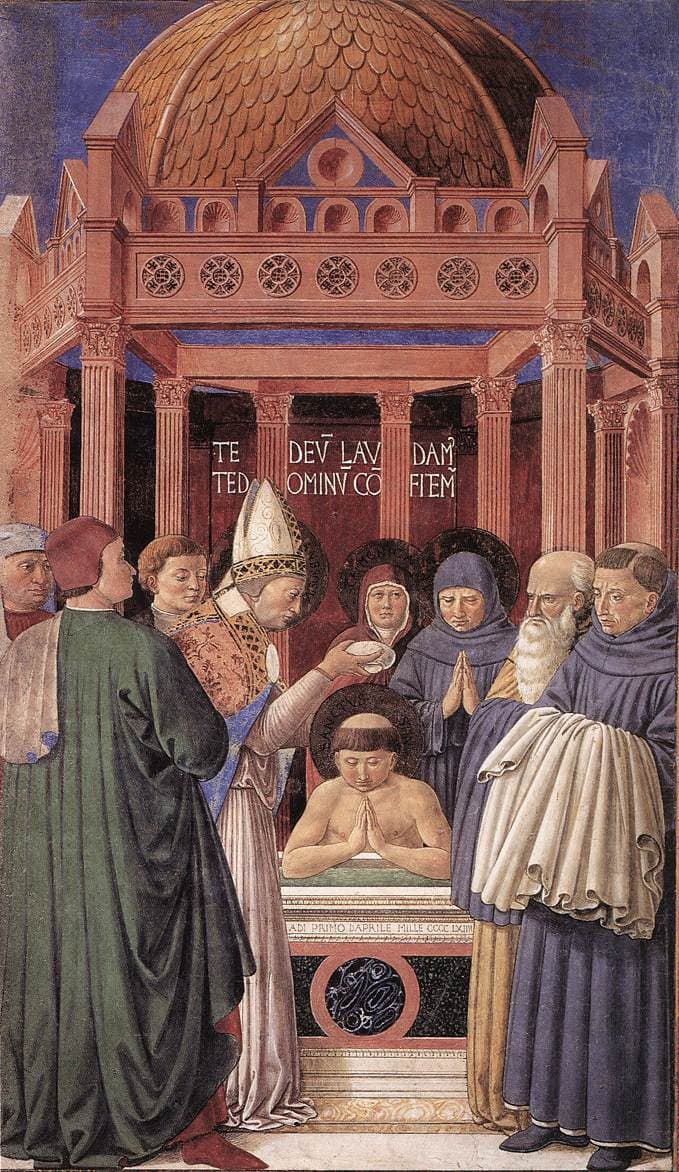
Cover: Baptism of Saint Augustine by Benozzo Gozzoli, public domain, via Wikimedia Commons. The artwork illustrates conversion and baptism; it does not depict contemporary survey participants. You can explore Augustine's own journey in our Saint Augustine biography.
