Catholic saint biography
St. Monica
- Commemoration:
- August 27
- Lived:
- About 331–387 — Thagaste, Roman North Africa
Current Roman memorial; older Western calendars used May 4.
Why dates and liturgical observances can differ
Read the sources for this biography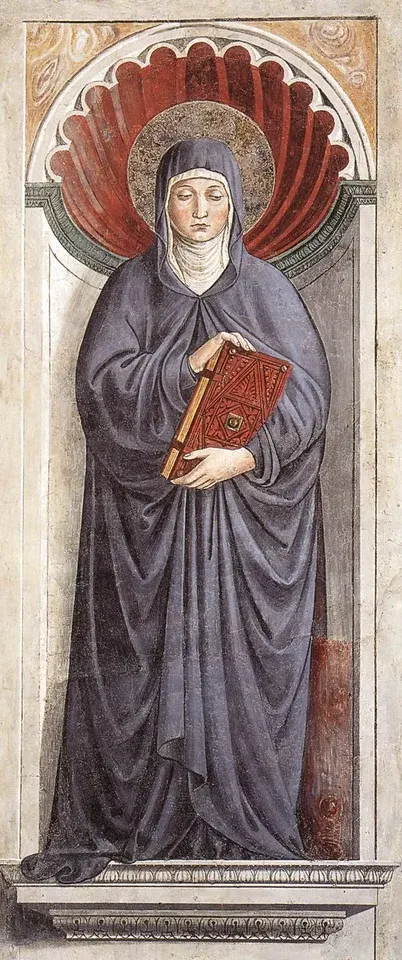
Biography
Monica was a North African Christian and the mother of Augustine of Hippo. Much of what is known about her comes from Augustine's Confessions, where he remembers her prayer, persistence, and concern for his spiritual life. Her household included her husband Patricius and three children.
Her life extended beyond anxiety over one son's conversion. Widowhood left her responsible for property and family affairs, while religious practice joined her to a local church community. Augustine's account gives readers access to those relationships through his own later interpretation, rather than through a memoir written by Monica herself.
She followed Augustine to Italy and witnessed his baptism at Milan. Their shared conversation at Ostia became one of the most memorable passages in his account of conversion. Monica died there in 387 before the family returned to Africa. Her memory is inseparable from Augustine's testimony, but it also preserves the presence of a committed Christian laywoman within a complicated family history.
At Ostia their conversation turns from the visible world toward eternal life, placing her within Augustine's theological as well as personal story. Her death before the return voyage gives that passage particular poignancy. Reading the Confessions attentively preserves her importance without turning every remembered detail into a universal prescription for family relationships.
Context & contribution
A peacemaker who filtered what she repeated
In Confessions IX.9, Augustine describes a specific practice behind Monica's reputation for making peace. When people in conflict spoke bitterly to her about one another, she passed on only what might help reconciliation. She did not simply repeat each side's anger to the other.
The passage turns a domestic social skill into a subject of moral reflection. Hearing a complaint and transmitting it are separate actions, and Monica's restraint prevented her from becoming another participant in the quarrel. The testimony remains Augustine's retrospective portrait of his mother, but it preserves a more precise example of her agency than a general description of patience or maternal concern.
Explore the sources for this section
AI-assisted source comparison updated 2026-09-26. Editorial approach
From the Saint Discovery blog
Keep exploring your faith
Practical guides to prayer, the saints, and living the Catholic faith.
What Is the Domestic Church? John Paul II on Faith at Home
What Catholics mean by the domestic church, how John Paul II explained family life, and practical ways to begin with prayer, forgiveness and welcome.
Bring reflection into prayerRead the article Prayer & reflectionHow to Make a Spiritual Communion When You Cannot Receive
Learn how to make a spiritual communion, with a short original prayer and clear guidance on Mass, Confession, and times when you cannot receive.
Bring reflection into prayerRead the articleFrom reading to reflection
What will you carry with you?
After reading about St. Monica, take a moment to consider:
- Take a fictional dispute between two neighbors and rewrite each person's complaint into a truthful message that could aid reconciliation, following the practice Augustine attributes to Monica.
These are reflection prompts from Saint Discovery, not quotations from the saint.
Sources and further reading
Biography source comparison recorded on . This is an AI-assisted comparison, not independent human or ecclesiastical approval.
What the recorded review covers
AI-assisted expansion of the existing source-reviewed biography with comparison to retrieved cited sources; not ecclesiastical approval
A source list helps you check an account; it does not establish that every claim is certain. Follow the biography’s qualifications about historical evidence, traditions and feast calendars.
Suggest a correction to this biography
How we research these pages and handle corrections · Directory corrections log
Explore this saint in everyday life
More lives to explore
Suggestions based on the site’s quiz themes, not a historical relationship or a measure of holiness.