Catholic saint biography
St. Mariana de Jesús de Paredes
- Commemoration:
- May 26
- Lived:
- 1618–1645 — Quito, present-day Ecuador
Why dates and liturgical observances can differ
Read the sources for this biography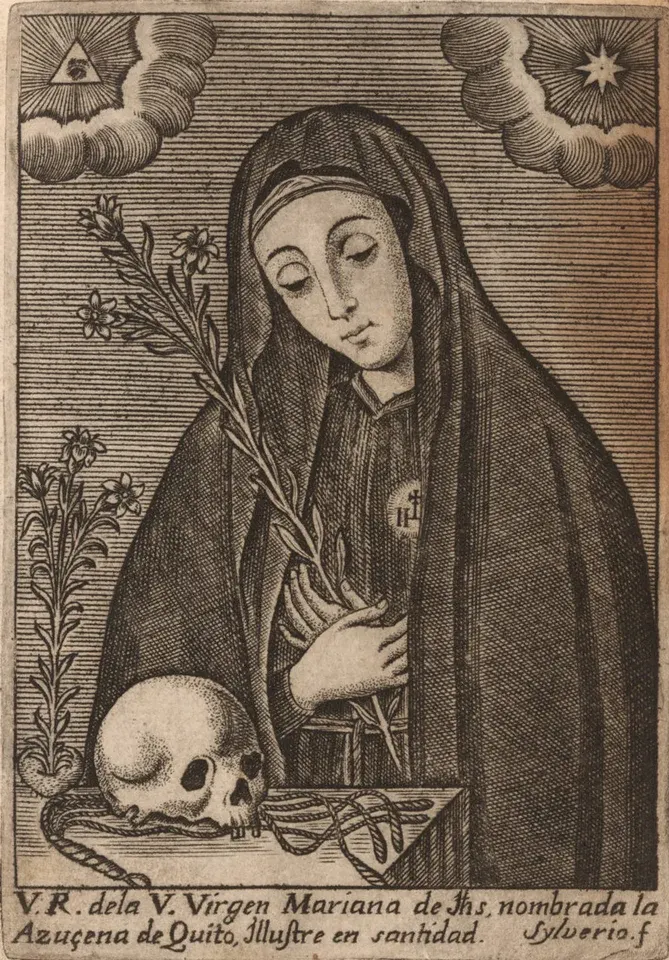
Biography
Mariana de Jesús de Paredes was born in Quito and pursued a life of prayer and asceticism while living in her family home. Guided by Jesuit confessors, she arranged her daily life around religious devotion rather than marriage or a conventional household role. Later tradition called her the Lily of Quito.
Her home in Quito became the setting of an intentional religious life without formal enclosure. The official cause also connects her with the Franciscan Third Order and assistance to poor Indigenous and Black people. These dimensions keep her story grounded in the city's social life rather than only in reports of extraordinary asceticism.
Accounts of her final illness connect her self-offering in prayer with the disasters troubling the city. This belongs to the devotional interpretation of her life and should not be treated as a demonstrable cause of events. She died in 1645 and was canonized by Pius XII in 1950. Her feast on May 26 recalls her death anniversary.
The disasters associated with her final illness made her memory especially important to Quito. Later accounts interpreted the sequence through the language of sacrifice and protection. Her early death and enduring civic devotion are historical features of the cult; claims that her illness caused a disaster to end belong to the devotional interpretation.
Context & contribution
A religious figure in Ecuador's civic memory
Mariana's public legacy includes a distinction outside the canonization process. The Ecuadorian National Assembly's archive records that its constituent assembly approved an agreement declaring the then Blessed Mariana a national heroine on November 30, 1946. The same session considered creating an order of honor bearing her name.
That parliamentary record documents how a seventeenth-century religious figure entered the civic vocabulary of modern Ecuador. It does not establish every event related in her devotional life; rather, it is direct evidence of how a later nation chose to remember her. Her national recognition and her subsequent Catholic canonization belong to different institutions and should be studied as separate acts of commemoration.
Explore the sources for this section
AI-assisted source comparison updated 2026-09-26. Editorial approach
From the Saint Discovery blog
Keep exploring your faith
Practical guides to prayer, the saints, and living the Catholic faith.
What Is the Domestic Church? John Paul II on Faith at Home
What Catholics mean by the domestic church, how John Paul II explained family life, and practical ways to begin with prayer, forgiveness and welcome.
Bring reflection into prayerRead the article Prayer & reflectionHow to Make a Spiritual Communion When You Cannot Receive
Learn how to make a spiritual communion, with a short original prayer and clear guidance on Mass, Confession, and times when you cannot receive.
Bring reflection into prayerRead the articleFrom reading to reflection
What will you carry with you?
After reading about St. Mariana de Jesús de Paredes, take a moment to consider:
- Read the assembly's description of Act 99 and identify which decisions concern national memory, then explain why a parliamentary honor and canonization answer different questions.
These are reflection prompts from Saint Discovery, not quotations from the saint.
Sources and further reading
Biography source comparison recorded on . This is an AI-assisted comparison, not independent human or ecclesiastical approval.
What the recorded review covers
AI-assisted expansion of the existing source-reviewed biography with comparison to retrieved cited sources; not ecclesiastical approval
A source list helps you check an account; it does not establish that every claim is certain. Follow the biography’s qualifications about historical evidence, traditions and feast calendars.
Suggest a correction to this biography
How we research these pages and handle corrections · Directory corrections log
More lives to explore
Suggestions based on the site’s quiz themes, not a historical relationship or a measure of holiness.