Catholic saint biography
St. Louise de Marillac
- Commemoration:
- May 9
- Lived:
- 1591–1660 — France
Current Vincentian-calendar feast; March 15 is her death date and former observance.
Why dates and liturgical observances can differ
Read the sources for this biography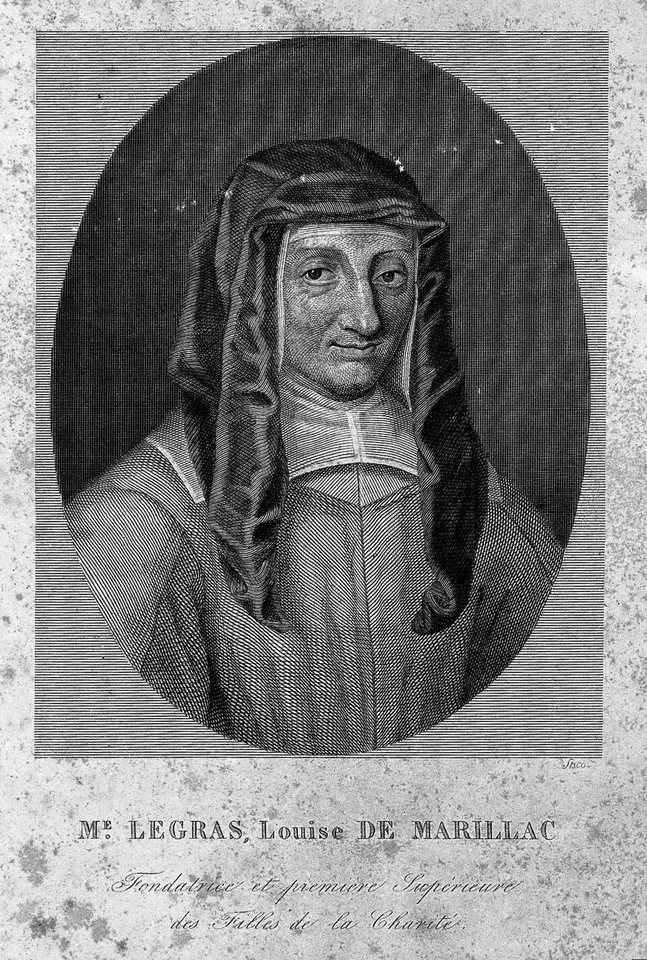
Biography
Louise de Marillac married Antoine Le Gras and became the mother of a son, Michel. After her husband's death she devoted increasing attention to charitable work, assisted by Vincent de Paul. Together they founded the Daughters of Charity in 1633, bringing women into organized service of poor, sick, and abandoned people.
Her early responsibilities as a wife and mother did not disappear from the story when she became a foundress. Organizing charitable service required attention to food, nursing, instruction, and the conditions in which sisters worked. Training and supervision helped transform individual generosity into reliable care for vulnerable people.
Louise trained the sisters and sustained their practical ministries, including care for foundlings and assistance during war and displacement. Her vocation developed through marriage, motherhood, widowhood, and community leadership. She died in Paris in 1660 and was canonized in 1934. The Daughters of Charity now celebrate her on May 9, replacing their former March observance.
The Daughters' active ministry brought them into streets, homes, and hospitals. That pattern gave women's religious service a distinctive public presence. Her partnership with Vincent should not obscure her own organizational contribution: she helped prepare the women whose daily work sustained the institutions and reached those unable to seek assistance elsewhere.
Context & contribution
Marguerite Naseau and the social origins of a company
The Daughters of Charity's own history names Marguerite Naseau alongside Louise and Vincent in the foundation story. A village woman who taught herself to read and instructed children, Marguerite came to Paris in 1630 to offer practical service. Other women from modest backgrounds followed her.
Their participation addressed a difficulty in the earlier charitable confraternities: social conventions limited the direct service wealthy women could undertake, and sending servants did not create the same commitment. Louise's task included forming women whose experience of poverty gave them a different relationship to those they served. The congregation's origins thus reveal a collaboration across social classes rather than charity flowing only from wealthy patrons.
Explore the sources for this section
AI-assisted source comparison updated 2026-09-26. Editorial approach
From the Saint Discovery blog
Keep exploring your faith
Practical guides to prayer, the saints, and living the Catholic faith.
St. Josephine Bakhita: Hope Without Denying Suffering
Learn what St. Josephine Bakhita teaches about Christian hope, dignity, and freedom, with practical reflection prompts and an original prayer.
Faith in difficult timesRead the article Prayer & reflectionWhat Is Redemptive Suffering? A Catholic Guide
What is redemptive suffering? Learn what Catholics mean by offering it up, how to unite suffering to Christ, and why seeking help belongs with faith.
Faith in difficult timesRead the articleFrom reading to reflection
What will you carry with you?
After reading about St. Louise de Marillac, take a moment to consider:
- Compare the roles of a wealthy confraternity member, Marguerite Naseau, and Louise; identify the knowledge and limitations each brought to organized care.
These are reflection prompts from Saint Discovery, not quotations from the saint.
Sources and further reading
Biography source comparison recorded on . This is an AI-assisted comparison, not independent human or ecclesiastical approval.
What the recorded review covers
AI-assisted expansion of the existing source-reviewed biography with comparison to retrieved cited sources; not ecclesiastical approval
A source list helps you check an account; it does not establish that every claim is certain. Follow the biography’s qualifications about historical evidence, traditions and feast calendars.
Suggest a correction to this biography
How we research these pages and handle corrections · Directory corrections log
More lives to explore
Suggestions based on the site’s quiz themes, not a historical relationship or a measure of holiness.