Catholic saint biography
St. Julia of Corsica
- Commemoration:
- May 22
- Patron Saint of:
- Corsica
- Lived:
- Date uncertain; late antiquity — Traditionally Carthage, North Africa
Western commemoration May 22; OCA commemorates Julia of Carthage on July 16.
Why dates and liturgical observances can differ
Read the sources for this biography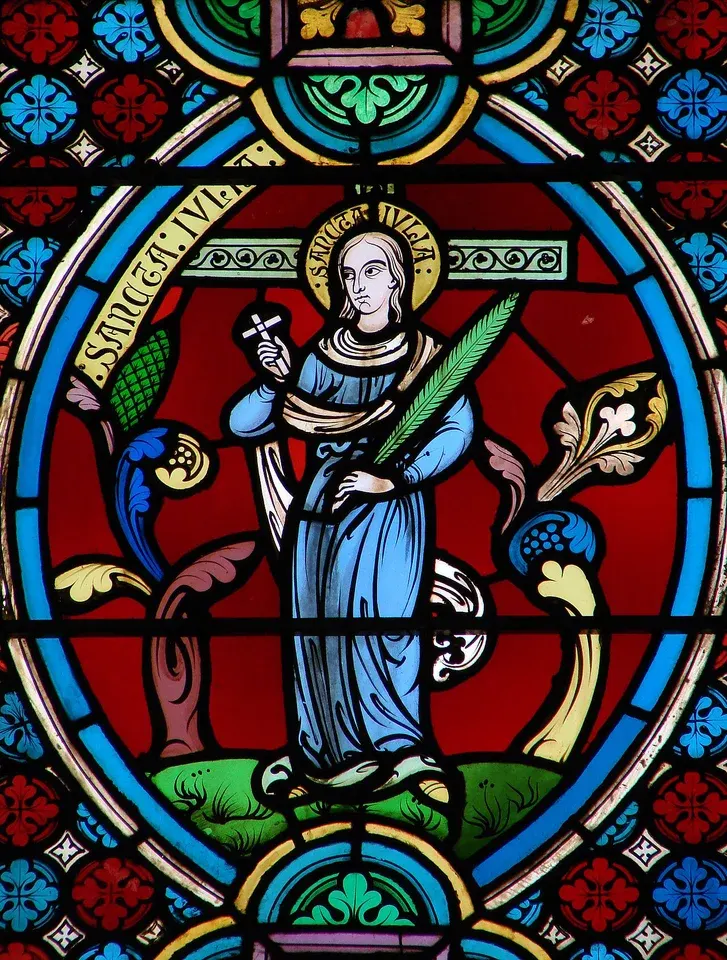
Biography
Julia is venerated as a Christian martyr associated with Corsica. Her traditional account describes a woman from Carthage sold into slavery and taken on a trading voyage. During a stop in Corsica, she refused to participate in pagan worship and was killed. Western and Eastern accounts connect her martyrdom with crucifixion and praise her fidelity under coercion.
In the traditional story her work in an enslaver's household is set beside her continued prayer and Christian observance. The voyage explains how a woman associated with North Africa came to be honored in Corsica. It is a narrative of forced displacement, not a securely documented missionary journey undertaken by choice.
The narrative's chronology and circumstances vary substantially: sources propose different centuries and disagree about her capture. A precise birth or death year is therefore unjustified. Her cult and the later veneration of her relics are more secure than the dramatic details of her life. Remembered as Corsica's patron, she represents Christian endurance and dignity in the face of enslavement.
The place-name Nonza and the image of a cross recur in her devotional remembrance. They help readers recognize her in local worship and art. Variations in chronology mean that the circumstances of Carthage's capture cannot simply be selected from one retelling and combined with an execution date from another.
Context & contribution
A cult carried across the Mediterranean
The Orthodox account places a transfer of Julia's relics to a women's monastery in Brescia around 763. This later stage of remembrance broadens the geography beyond Carthage and Corsica: a martyr's cult could acquire a new center through the movement of relics and the community that received them.
The same account acknowledges conflicting centuries for her death. The relic tradition and the martyrdom story consequently answer different historical questions. One concerns how communities preserved and relocated her memory; the other attempts to describe a life whose chronology remains uncertain. A later monastery's devotion cannot by itself resolve that earlier dating problem.
Explore the sources for this section
AI-assisted source comparison updated 2026-09-26. Editorial approach
From the Saint Discovery blog
Keep exploring your faith
Practical guides to prayer, the saints, and living the Catholic faith.
Why Do Catholics Pray to Saints? Intercession Explained
Why do Catholics pray to saints? Learn how intercession differs from worship, how it relates to Jesus, and a simple way to ask a saint to pray for you.
A next step with your saintRead the article Living the seasonsHow to Celebrate Your Patron Saint's Feast Day at Home
Celebrate your patron saint's feast day with prayer, a short biography, and an act of kindness. A practical plan for families, sponsors, and individuals.
A next step with your saintRead the articleFrom reading to reflection
What will you carry with you?
After reading about St. Julia of Corsica, take a moment to consider:
- Create two timelines, one for Julia's uncertain lifetime and one for later relic traditions; explain why the second cannot automatically supply missing dates in the first.
These are reflection prompts from Saint Discovery, not quotations from the saint.
Sources and further reading
Biography source comparison recorded on . This is an AI-assisted comparison, not independent human or ecclesiastical approval.
What the recorded review covers
AI-assisted expansion of the existing source-reviewed biography with comparison to retrieved cited sources; not ecclesiastical approval
A source list helps you check an account; it does not establish that every claim is certain. Follow the biography’s qualifications about historical evidence, traditions and feast calendars.
Suggest a correction to this biography
How we research these pages and handle corrections · Directory corrections log
More lives to explore
Suggestions based on the site’s quiz themes, not a historical relationship or a measure of holiness.