Catholic saint biography
St. Fiacre
- Commemoration:
- August 30
- Patron Saint of:
- gardeners
- Lived:
- Seventh century — Ireland; Breuil, France
Traditional feast on August 30; accounts also associate August 18 with his death.
Why dates and liturgical observances can differ
Read the sources for this biography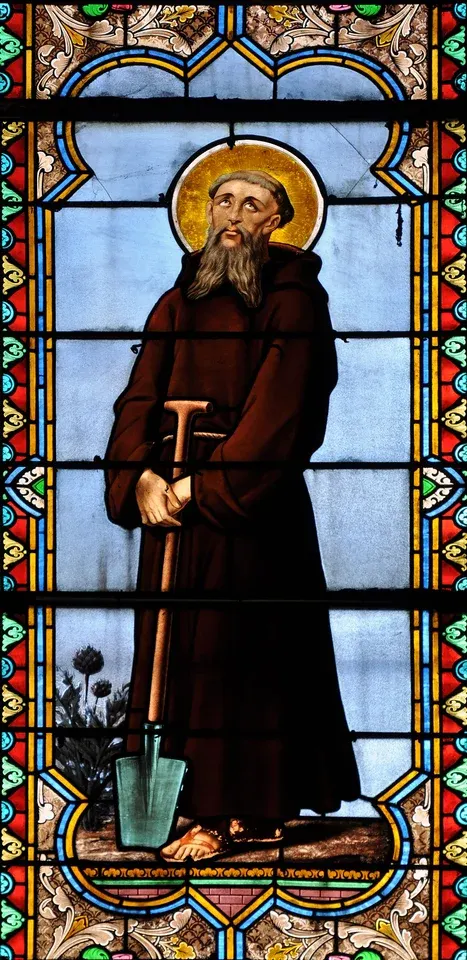
Biography
Fiacre was an Irish religious who established a hermitage near Meaux in present-day France. His remembered life joined prayer, cultivation, and hospitality, and he became a traditional patron of gardeners.
According to his Life, he sought greater solitude after disciples gathered around him in Ireland. Bishop Faro welcomed him in Gaul and provided land at Breuil. There Fiacre built an oratory dedicated to Mary, a place to receive travelers, and accommodation for himself.
A community developed around this foundation. Later legend explained the extent of its land by describing Fiacre clearing a boundary with his staff in a single day. That miraculous episode belongs to devotional storytelling rather than independently verified land records.
His shrine drew pilgrims seeking healing, and churches throughout France adopted his name. His association with gardens reflects both cultivation in the traditional biography and the later history of his cult. Even the French word for a hired carriage, fiacre, became linked to an establishment bearing his image. These enduring cultural connections are better documented than many precise details of his childhood or early travels.
Context & contribution
The movement of relics and a changing cult
Fiacre's relics were placed in a shrine at Breuil in 1234, with an arm housed separately. Later transfers brought the shrine to Meaux during the religious conflicts of the sixteenth century, and portions were subsequently given to prominent patrons.
These movements help explain how a local hermit's devotion became geographically dispersed. They document the history of remembrance more securely than the legendary clearing of land with a staff. A relic's later destination tells us about patrons and communities maintaining a cult; it does not prove that Fiacre personally travelled to every place honoring him.
Explore the sources for this section
AI-assisted source comparison updated 2026-09-26. Editorial approach
From the Saint Discovery blog
Keep exploring your faith
Practical guides to prayer, the saints, and living the Catholic faith.
What Is the Domestic Church? John Paul II on Faith at Home
What Catholics mean by the domestic church, how John Paul II explained family life, and practical ways to begin with prayer, forgiveness and welcome.
Bring reflection into prayerRead the article Prayer & reflectionHow to Make a Spiritual Communion When You Cannot Receive
Learn how to make a spiritual communion, with a short original prayer and clear guidance on Mass, Confession, and times when you cannot receive.
Bring reflection into prayerRead the articleFrom reading to reflection
What will you carry with you?
After reading about St. Fiacre, take a moment to consider:
- Make a map distinguishing Fiacre's remembered lifetime locations from destinations of his relics. Explain why those are two different kinds of journey.
These are reflection prompts from Saint Discovery, not quotations from the saint.
Sources and further reading
Biography source comparison recorded on . This is an AI-assisted comparison, not independent human or ecclesiastical approval.
What the recorded review covers
AI-assisted expansion checked against cited sources; historical traditions distinguished from documented evidence; not ecclesiastical approval
A source list helps you check an account; it does not establish that every claim is certain. Follow the biography’s qualifications about historical evidence, traditions and feast calendars.
Suggest a correction to this biography
How we research these pages and handle corrections · Directory corrections log
More lives to explore
Suggestions based on the site’s quiz themes, not a historical relationship or a measure of holiness.