Catholic saint biography
St. Barbara
- Commemoration:
- December 4
- Lived:
- Dates uncertain — Place of origin uncertain
Why dates and liturgical observances can differ
Read the sources for this biography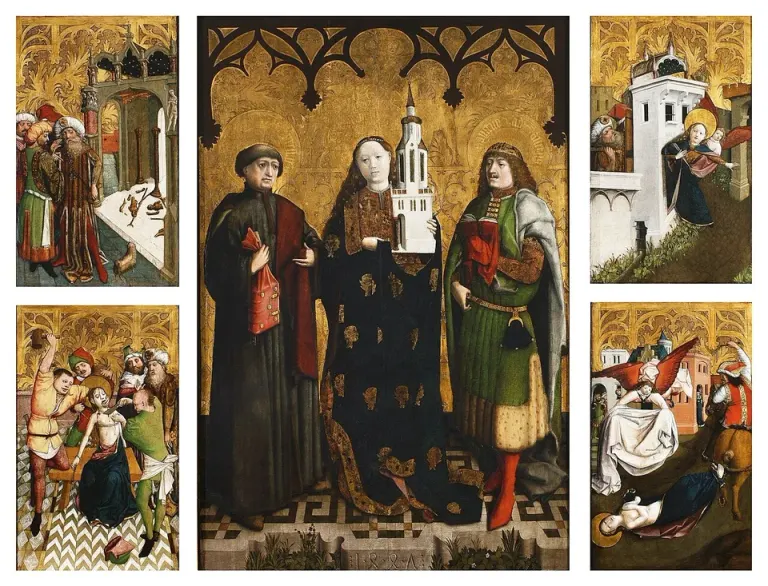
Biography
Barbara has been widely venerated as a virgin and martyr since the early medieval period. Her familiar story describes a young Christian confined by her father in a tower, confessing her faith and suffering execution. However, the surviving narratives are legendary and disagree about her location and historical setting.
In the developed legend, the three windows represent belief in the Trinity. The tower is therefore more than a picturesque prison: it became a visual way of identifying the saint and the faith attributed to her. Her father’s punishment by lightning explains another recurring element in her imagery.
The Catholic Encyclopedia notes that early historical authorities do not provide the narrative familiar from later devotion. Conflicting places and rulers in the stories cannot be combined into one secure chronology. December 4 preserves a longstanding commemoration despite those limits.
Her tower and its three windows became enduring symbols in Christian art. Traditions surrounding lightning in her story contributed to her association with protection from sudden danger, and to devotion among artillerymen and miners. Her established history of veneration should be distinguished from an exact biography: neither a precise birth year nor the details of her death can be securely reconstructed.
Context & contribution
Images joined several forms of danger
Barbara's art may include a chalice and Eucharistic bread as well as the familiar tower. The Catholic Encyclopedia connects these objects with devotion seeking the sacraments at the approach of death. Her visual identity therefore gathers concerns about faith, sudden danger, and preparation for dying.
Artillerymen's and miners' patronage developed by association with the lightning and fire in her legend. This is a history of how occupations adopted a saint, not evidence that Barbara practiced those trades. Her case offers an especially clear example of a widespread cultural legacy that can be studied responsibly even while the underlying personal narrative remains historically uncertain.
Explore the sources for this section
AI-assisted source comparison updated 2026-09-26. Editorial approach
From the Saint Discovery blog
Keep exploring your faith
Practical guides to prayer, the saints, and living the Catholic faith.
St. Josephine Bakhita: Hope Without Denying Suffering
Learn what St. Josephine Bakhita teaches about Christian hope, dignity, and freedom, with practical reflection prompts and an original prayer.
Faith in difficult timesRead the article Prayer & reflectionWhat Is Redemptive Suffering? A Catholic Guide
What is redemptive suffering? Learn what Catholics mean by offering it up, how to unite suffering to Christ, and why seeking help belongs with faith.
Faith in difficult timesRead the articleFrom reading to reflection
What will you carry with you?
After reading about St. Barbara, take a moment to consider:
- Compare Barbara's tower, chalice, and cannon in religious art. What different concerns of later worshippers does each symbol make visible?
These are reflection prompts from Saint Discovery, not quotations from the saint.
Sources and further reading
Biography source comparison recorded on . This is an AI-assisted comparison, not independent human or ecclesiastical approval.
What the recorded review covers
AI-assisted expansion checked against retrieved historical and institutional sources; traditions distinguished from documented history; not ecclesiastical approval
A source list helps you check an account; it does not establish that every claim is certain. Follow the biography’s qualifications about historical evidence, traditions and feast calendars.
Suggest a correction to this biography
How we research these pages and handle corrections · Directory corrections log
More lives to explore
Suggestions based on the site’s quiz themes, not a historical relationship or a measure of holiness.