Catholic saint biography
St. Anne
- Commemoration:
- July 26
- Lived:
- Dates unknown — Traditionally associated with the Holy Land
Why dates and liturgical observances can differ
Read the sources for this biography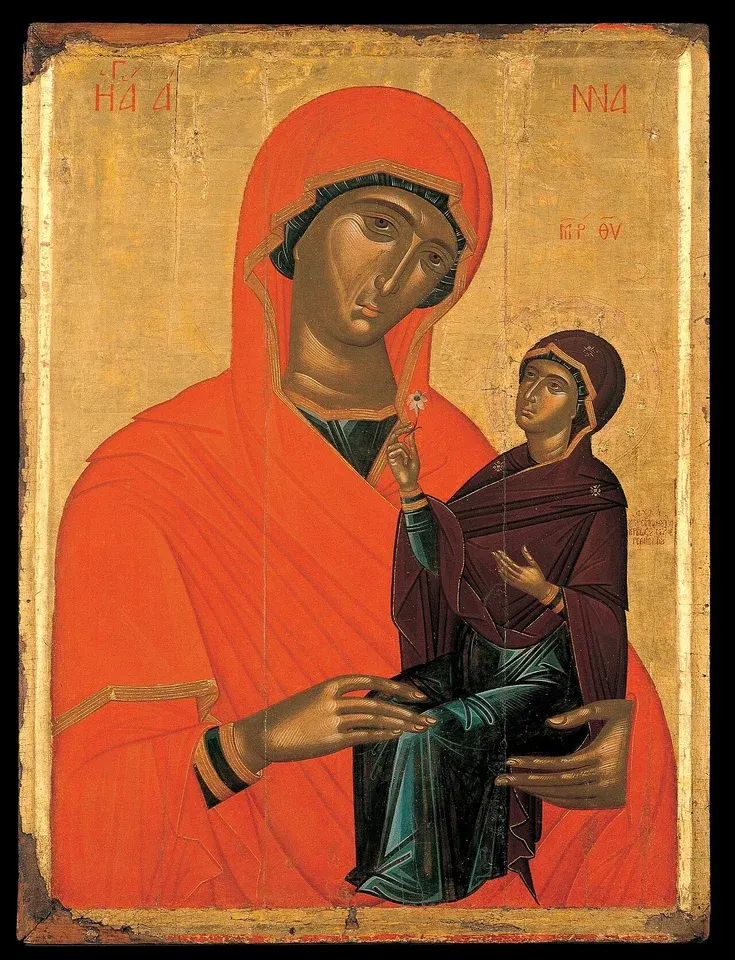
Biography
Anne is the traditional name of Mary’s mother and Jesus’ grandmother. The canonical Gospels do not name Mary’s parents. The names Anne and Joachim, and stories about their longing for a child, come from early noncanonical Christian writings, especially the Protoevangelium of James.
The best-known traditional narrative describes a childless couple whose prayers are answered with the birth of Mary. It also relates a promise to dedicate their child to God. Its resemblance to biblical stories of Hannah and Samuel helps explain its religious language, but does not make it part of the canonical Gospel record.
Devotion to Anne developed in Eastern Christianity and later spread widely in the West. That history explains her prominence in religious art even though the New Testament supplies no personal narrative about her. Depictions of Anne with Mary express devotional reflection on family and faith across generations.
Those writings influenced Christian devotion and art, but do not establish a documented chronology of Anne’s life. Her importance in Catholic devotion centers on Mary’s family and the transmission of faith between generations. The Church celebrates Anne and Joachim together on July 26; precise birth dates and elaborate family histories should be treated with caution.
Context & contribution
The difference between scriptural and devotional reception
The Protoevangelium of James influenced Eastern Christian observances and, through later retellings, western devotion to Anne. Its cultural importance does not make it a canonical Gospel. This distinction allows readers to explain why an image or feast is familiar even when its narrative details cannot be found in the New Testament.
The Catholic Encyclopedia also traces the growth of the story through the Golden Legend. That history concerns how Christians imagined Mary's family over time. Anne's artistic presence can therefore be studied as reflection on generations, parenthood, and formation without claiming that a medieval depiction supplies evidence of a particular lesson she taught or a documented scene in her home.
Explore the sources for this section
AI-assisted source comparison updated 2026-09-26. Editorial approach
From the Saint Discovery blog
Keep exploring your faith
Practical guides to prayer, the saints, and living the Catholic faith.
Why Is Saint Luke's Symbol an Ox? Meaning and Biblical Roots
Discover why Saint Luke's symbol is a winged ox, its biblical roots, and how the image connects his Gospel with priesthood and sacrifice.
Go deeper into ScriptureRead the article Prayer & reflectionHow to Pray the Jesus Prayer: A Catholic Beginner's Guide
Learn the Jesus Prayer, its Eastern Christian roots and biblical meaning, with a simple Catholic practice focused on Christ and mercy.
Go deeper into ScriptureRead the articleFrom reading to reflection
What will you carry with you?
After reading about St. Anne, take a moment to consider:
- Choose an artwork of Anne and Mary. Identify which meaning it expresses and which details would require a historical source beyond the image itself.
These are reflection prompts from Saint Discovery, not quotations from the saint.
Sources and further reading
Biography source comparison recorded on . This is an AI-assisted comparison, not independent human or ecclesiastical approval.
What the recorded review covers
AI-assisted expansion checked against retrieved historical and institutional sources; traditions distinguished from documented history; not ecclesiastical approval
A source list helps you check an account; it does not establish that every claim is certain. Follow the biography’s qualifications about historical evidence, traditions and feast calendars.
Suggest a correction to this biography
How we research these pages and handle corrections · Directory corrections log
More lives to explore
Suggestions based on the site’s quiz themes, not a historical relationship or a measure of holiness.