Catholic saint biography
St. Agnes of Rome
- Commemoration:
- January 21
- Lived:
- Early Christian era; traditionally died about 304 — Rome
Why dates and liturgical observances can differ
Read the sources for this biography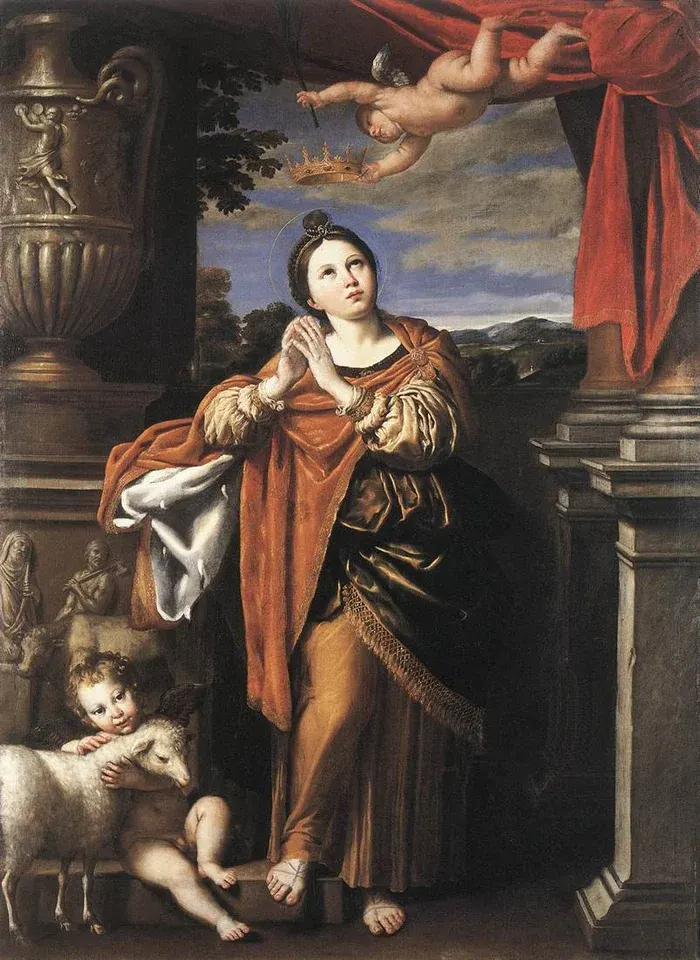
Biography
Agnes is one of Rome's most enduringly venerated early Christian martyrs. Remembered as a young woman dedicated to Christ, she became a symbol of fidelity under coercion. The accounts of her suffering were written after her death and do not agree on every detail.
Tradition commonly places her martyrdom during Diocletian's persecution, although an earlier setting under Valerian has also been proposed. Stories describe pressure to accept marriage or pagan worship and threats intended to break her religious commitment. Their miraculous episodes and dramatic scenes are features of later hagiography, not surviving contemporary court testimony.
Her burial place on the Via Nomentana became a center of Christian devotion. That enduring connection to a place, together with the early memory of her martyrdom, is more secure than attempts to reconstruct her childhood or an exact sequence of punishments.
Agnes is often shown with a lamb. Her January 21 feast is also associated with lambs whose wool contributes to the pallia worn by metropolitan archbishops. The Vatican's account of the continuing custom explains how her memory remains connected with the Church's pastoral life. The artistic symbol and liturgical practice belong to her legacy, while the uncertainties in her biography should remain clearly identified.
Context & contribution
The early witnesses do not tell one identical story
Agnes appears in the Roman calendar preserved in the collection of 354, which records both her feast and the road near her grave. This is a different kind of evidence from a dramatic narrative: it anchors an established commemoration to a place without supplying a full account of the execution.
Ambrose, Damasus, and Prudentius subsequently celebrated her in prose, inscription, and poetry. Their accounts emphasize her youth but differ over the manner of suffering. Reading these witnesses side by side shows how a martyr could become a powerful teacher of Christian courage through several literary forms, while the precise events remained incompletely known.
Explore the sources for this section
AI-assisted source comparison updated 2026-09-26. Editorial approach
From the Saint Discovery blog
Keep exploring your faith
Practical guides to prayer, the saints, and living the Catholic faith.
St. Josephine Bakhita: Hope Without Denying Suffering
Learn what St. Josephine Bakhita teaches about Christian hope, dignity, and freedom, with practical reflection prompts and an original prayer.
Faith in difficult timesRead the article Prayer & reflectionWhat Is Redemptive Suffering? A Catholic Guide
What is redemptive suffering? Learn what Catholics mean by offering it up, how to unite suffering to Christ, and why seeking help belongs with faith.
Faith in difficult timesRead the articleFrom reading to reflection
What will you carry with you?
After reading about St. Agnes of Rome, take a moment to consider:
- Compare what a dated calendar proves with what a commemorative poem conveys. Why should neither kind of source be asked to do the other's work?
These are reflection prompts from Saint Discovery, not quotations from the saint.
Sources and further reading
Biography source comparison recorded on . This is an AI-assisted comparison, not independent human or ecclesiastical approval.
What the recorded review covers
AI-assisted expansion checked against retrieved historical and institutional sources; traditions distinguished from documented history; not ecclesiastical approval
A source list helps you check an account; it does not establish that every claim is certain. Follow the biography’s qualifications about historical evidence, traditions and feast calendars.
Suggest a correction to this biography
How we research these pages and handle corrections · Directory corrections log
More lives to explore
Suggestions based on the site’s quiz themes, not a historical relationship or a measure of holiness.