In a saint's name, Confessor refers to someone honored for professing and living the Christian faith. It traditionally distinguishes a saint from a martyr, while also carrying a history of courageous witness under pressure. It does not mean that the saint was a priest who heard confessions.
Saint Edward the Confessor makes the distinction memorable: he was a king. Saint Maximus the Confessor shows another side of the title through his costly defense of the faith. Understanding the word helps you read their stories without confusing a spiritual witness with a sacramental ministry.
Two meanings of the same word
Catholics often use confessor to mean the priest to whom someone confesses sins in the sacrament of Reconciliation. The Catechism, paragraphs 1461–1467, explains this ministry of bishops and priests and the care, discretion, and mercy it requires.
A saint's title uses the word differently. Here, confessing means acknowledging or professing faith. Think of the difference between confessing a sin and professing belief in Christ: the same family of words can describe different actions.
The French Catholic liturgy service's definition of confessor explains both meanings. It also notes that older technical liturgical language used the designation for male saints who were not martyrs. This is why the title alone does not tell you someone's occupation or prove that he underwent a particular persecution.
When you encounter the word, ask what the sentence is describing. A person seeking a confessor is usually seeking a priest. A biography naming Edward the Confessor is identifying a saint.
How is a confessor different from a martyr?
The Catechism, paragraph 2473, describes martyrdom as witness to the truth of the faith carried even to death. Confessor and martyr therefore point toward a shared reality: faith expressed in a person's life, sometimes at terrible cost.
The distinction does not make confessors Christians who had an easy life. Nor does it turn the saints into a competition over who suffered most. The title is a starting point for learning what a particular person faced.
There is also a useful caution here. Do not assume every saint called Confessor survived persecution and then lived comfortably for decades. Read the actual biography. Historical titles preserve particular traditions of remembrance; they are not a complete account of how someone lived or died.
What Saint Maximus helps us understand
In his June 25, 2008 audience on Saint Maximus, Benedict XVI connects the title directly with Maximus's courage in professing faith in Jesus Christ as true God and true man.
The pope explains that Maximus defended Christ's genuine human will against a teaching that recognized only one will in Christ. This was not merely an argument about terminology. For Maximus, the fullness of Christ's humanity mattered to understanding salvation.
Benedict also recounts Maximus's trial, mutilation, and exile, followed by his death in 662. His example prevents us from reducing Confessor to a gentle synonym for someone who was religious. Faithful witness could involve sustained suffering and a refusal to abandon what one believed to be true.
For readers today, the first task is to understand the teaching at issue before borrowing the saint's language for a personal disagreement.
Why is Edward called the Confessor?
Edward's familiar title points to his sanctity as a Christian king rather than death as a martyr. Westminster Abbey's historical account records his canonization by Pope Alexander III in 1161 and explains the connection between his remembrance and the Abbey.
You can explore his life separately in our Saint Edward the Confessor biography. The title does not make him a priest, and it does not remove the need to examine the historical record of his reign.
October 13 is associated with the movement of his remains to a shrine in 1163. Westminster calls that movement a translation. Edward died on January 5, 1066, so the October date illustrates why a saint's observance need not fall on the anniversary of death.
Westminster Abbey is now an Anglican institution; its account is used here for the history of its own shrine. A date on a saint's biography should not be treated as an instruction that every Catholic parish celebrates the same liturgy. Follow your parish's calendar; our guide to solemnities, feasts, and memorials explains why context matters.
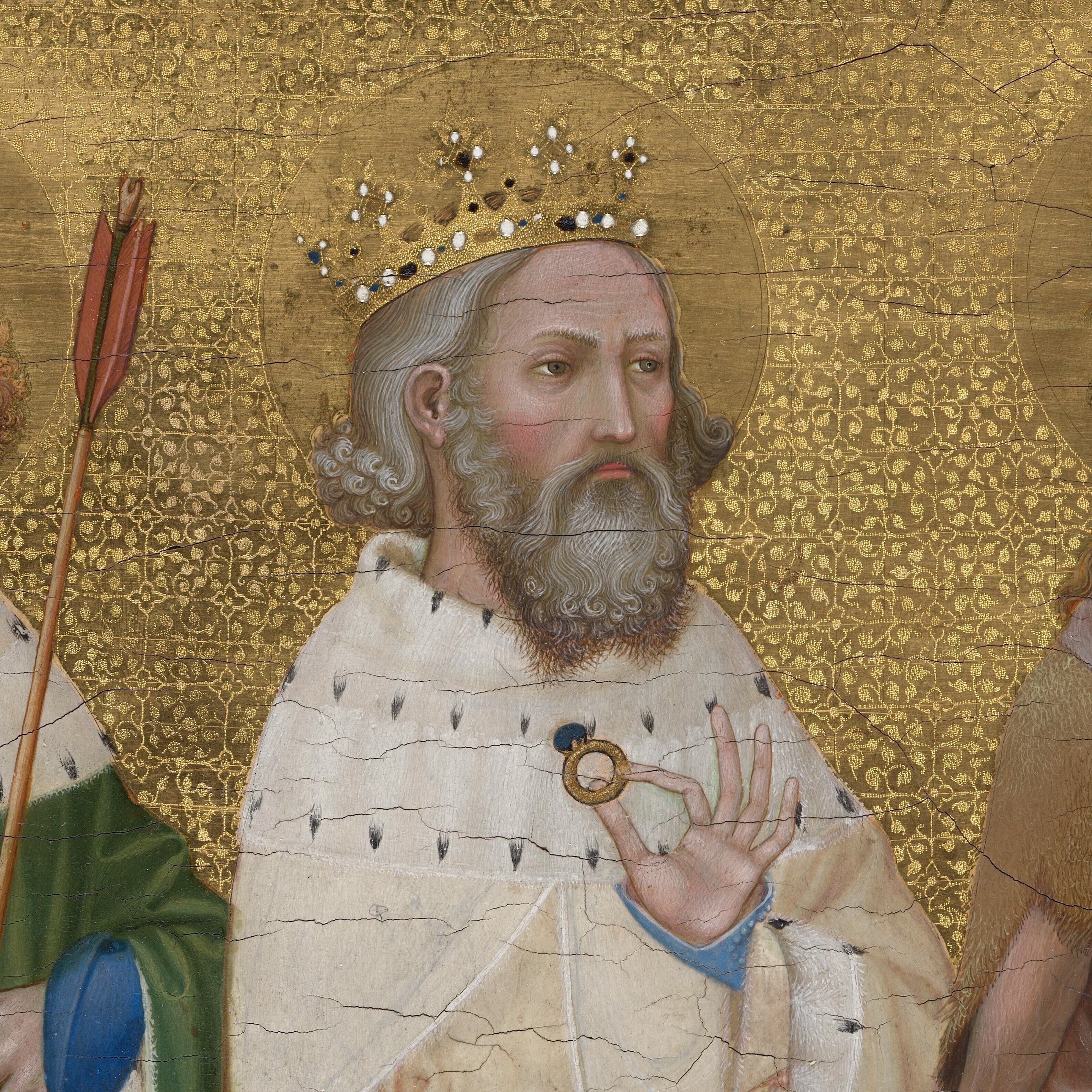
What does the ring in Edward's picture mean?
The cover shows a detail of Edward from the Wilton Diptych, painted about 1395–1399 by an unknown English or French artist. The National Gallery's catalogue identifies Edward by the ring he holds.
Westminster's account labels the ring story as legend: Edward gives a ring to a needy stranger, later identified in the story as Saint John the Evangelist. The painting is evidence of later devotion and artistic symbolism, not a contemporary portrait or proof that the episode happened.
The reproduction is identified as public domain on its Wikimedia Commons file page.

How to use this in a saint report or family conversation
Try this original reading exercise: choose one saint, explain the title in one sentence, and then find one sourced event that shows what it means in that person's life. Keep a documented event separate from a devotional legend.
For Edward, you might explain why a king can be called Confessor. For Maximus, you might describe the belief he defended and what that defense cost him. Our Confirmation saint report guide can help organize what you learn.
Finally, consider one ordinary situation that calls for honest witness: explaining your faith without belittling someone, admitting an error, or acting consistently with a responsibility. These are reflection prompts, not claims that everyday discomfort equals persecution. Let the saint's title lead you toward careful reading and a concrete act of faithfulness.