A good Confirmation saint report explains who your saint was, what their life teaches you about following Christ, and why you want that saint as a companion in faith. Start with reliable research, choose a few meaningful details, and write the personal reflection in your own words.
If the blank page is the hardest part, use the outline below. It is a writing aid, not a replacement for your parish's instructions or your own reflection.
Start with your parish's assignment
Before researching, check the required length, deadline, format, and questions. Ask your catechist whether you should discuss a saint, a blessed, your baptismal patron, or another permitted name. Your program's directions take priority over a template you find online.
For example, Annunciation Catholic Church's saint report instructions ask candidates to describe their chosen person's life, feast day, reasons for choosing them, and qualities they hope to imitate. That is one parish's assignment, not a universal rule about report length or name selection.
Keep the purpose of preparation in view. The Catechism, paragraph 1309, connects preparation for Confirmation with growing closer to Christ, knowing the Holy Spirit more deeply, and taking responsibility for Christian life. A thoughtful report can support that growth.
Research your saint without getting lost
Begin with a short biography to understand the broad story. Then check important details against a dependable source: a Vatican biography, a diocesan page, an official religious order website, a scholarly reference, or the saint's own writings in a reliable edition.
Our saint directory can help you find a starting point and links for further reading. If you have not chosen a saint yet, use the Confirmation saint selection guide before beginning the report.
Make a small research sheet with these fields:
Full name and any other name the saint is known by.
When and where the saint lived, noting approximate dates where necessary.
Vocation, family circumstances, or community.
Two or three important events or choices.
Feast day and the source used to verify it.
One virtue you want to understand more deeply.
Sources, including the title and link or book page number.
Do not turn an uncertain date into an exact one. If an account describes something as a tradition or legend, retain that qualification. When two websites repeat the same wording, look for the original source rather than treating them as independent confirmation.
A five-part Confirmation saint report outline
1. Introduce your chosen saint
Give the saint's name and briefly explain what first interested you. You can mention a family connection, a question about faith, or a virtue you admire. You do not need a dramatic experience to have a sincere reason.
Try this opening prompt: “I chose to learn about Saint ___ because ___. As I read about this saint, I became especially interested in ___.” Complete it with your own reasons rather than copying someone else's testimony.
2. Explain the setting of the saint's life
Tell the reader when and where the saint lived and enough about their circumstances to understand the story. A few well-chosen details are more useful than a long list of dates. Explain unfamiliar words, such as a religious order or historical title, if they matter to your account.
3. Describe a choice that reveals a virtue
Choose one event and explain what it shows. Instead of writing only “this saint was brave,” identify the decision, the difficulty, and the reason you see courage in it. Cite the source for the event. Keep your interpretation separate from what the source actually establishes.
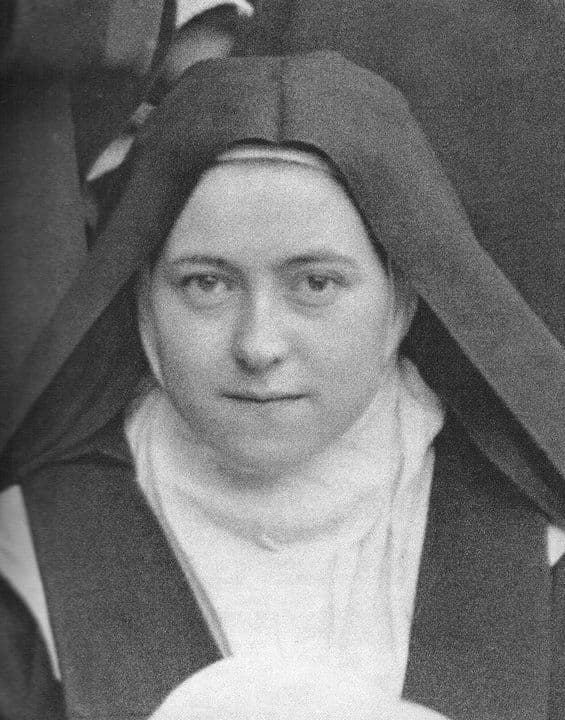
This is also a useful way to approach a familiar saint. Read our biography of Saint Thérèse of Lisieux, follow its sources, and ask which specific choice helps you understand her spirituality. A recognizable portrait or popular saying is an invitation to research, not the whole story.
4. Connect the example to your life
Move from admiration to something concrete. Where do you need more patience, honesty, generosity, or perseverance? What might practicing that virtue look like at home, at school, at work, or in your parish?
Here is an original example of the kind of connection you might make: “I want to practice patience by letting my younger sibling finish speaking before I respond.” This is a sample action, not a quotation from a saint or a claim about your own experience.
5. End with a realistic next step
Name one way you hope to keep learning after Confirmation. You might read a chapter of the saint's writings with your sponsor, remember their feast day, or ask for their prayers during a particular challenge. Choose something you can actually return to.
Cite your sources and keep your voice
Write the report after taking notes, rather than rewriting each sentence of a biography with a few words changed. Put any exact quotation in quotation marks and identify where it comes from. Avoid quote graphics unless you can trace the wording to a dependable source.
If your parish does not specify a citation style, a short source list can include the author or organization, page or book title, website address or publication details, and the date you accessed it. Ask your catechist if a formal bibliography is required.
A worked paragraph: moving from a fact to a reflection
Here is an original teaching example, not a student's testimony or a paragraph to submit as your own. In his 2011 audience on Thérèse of Lisieux, Benedict XVI recounts her concern and prayer for a condemned criminal when she was fourteen. That source gives you a concrete episode to investigate, rather than only the general statement that she was loving.
A research sentence could explain the episode and cite the audience. An interpretation could then say that her concern reached someone whom others might consider beyond hope. A personal response should come from the actual writer: perhaps a question about mercy, a difficulty forgiving someone, or an intention to pray for people they would usually dismiss. Do not claim the saint guaranteed another person's salvation or invent a feeling you never had.
The three parts do different jobs: the source establishes the episode, the interpretation explains why it matters, and the reflection connects it to your own life. Keeping them separate makes the report both more thoughtful and easier to check.
What if two sources disagree?
Record the disagreement before choosing a detail. Check whether the pages refer to the same person, whether a date is approximate, and whether one account labels an event as a later tradition. Prefer an identifiable source close to the subject over repeated anonymous summaries. If uncertainty remains, write it honestly or leave out a detail that your argument does not need.
For teachers and sponsors, ask the writer to show one source and explain one choice in their own words. Our printable teacher resources can support that conversation. A finished report should reveal what the candidate has understood, not simply how much polished text they have collected.
A checklist before you hand it in
I followed my parish's questions, length, and naming instructions.
I checked the saint's identity, dates, and feast day.
I explained an example of virtue instead of only listing achievements.
My personal reflection describes my real reasons and intentions.
I cited facts and quotations and distinguished uncertain traditions.
I read the report aloud and corrected unclear sentences.
Common questions
How long should a Confirmation saint report be?
Use the length your parish or school assigns. If none is provided, ask before writing several pages. This outline can be shortened to a few paragraphs or expanded with additional research.
Can I write about a saint I already knew?
You can begin with a familiar saint and still discover something new. Check that your choice meets your program's directions, then investigate a specific part of the saint's life rather than relying on what you remember.
What if I do not feel a strong connection yet?
Be honest. Write about what interests or challenges you, and discuss your questions with your sponsor or catechist. A relationship with a saint's example can develop through reading and prayer; you do not need to invent an emotional story.
When the report is finished, consider a simple way to celebrate your patron saint's feast day. The writing can become the beginning of an ongoing practice.
Sources and further reading
Catechism of the Catholic Church, 1306–1311: preparation and candidates for Confirmation.
Annunciation Catholic Church: Confirmation Name Selection and Report Instructions (PDF), cited as an example of a local assignment.
Cover photograph: Thérèse of Lisieux, by Céline Martin, public domain.
