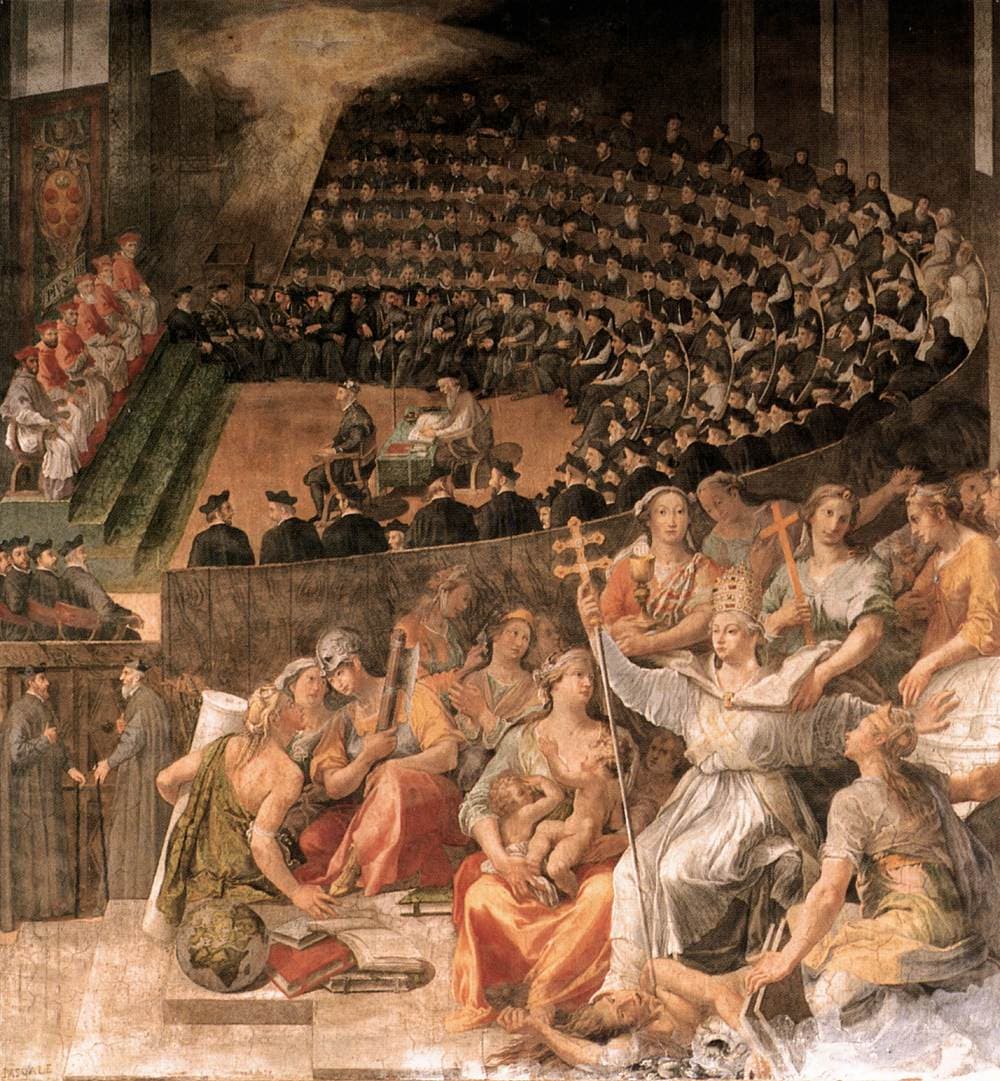
An ecumenical council is a solemn gathering of the Church’s bishops, acting together with the pope, to address matters affecting the universal Church. Councils can clarify doctrine, respond to disputes, reform Church discipline, and guide its mission. In Catholic teaching, their authority belongs to the bishops united with their head, the successor of Saint Peter. See the Code of Canon Law, canons 336–341.
The Catholic Church recognizes 21 ecumenical councils. The first was Nicaea in 325; the most recent was Vatican II, held from 1962 to 1965. Their influence reaches into ordinary Catholic life, from the Creed at Mass to how the Church explains Jesus’ identity and its own mission.
What does “ecumenical” mean?
In this setting, ecumenical refers to the whole Church, rather than a single diocese or region. Vatican II’s Lumen Gentium explains that an ecumenical council involves the college of bishops with the pope; papal confirmation or acceptance is essential to its recognition. Read Lumen Gentium, section 22.
The term can cause confusion because ecumenism also describes efforts toward Christian unity. An ecumenical council is a particular kind of Church assembly. Ecumenism is a broader work of prayer, dialogue, and reconciliation. For that related subject, read our Catholic guide to ecumenism.
The 21 ecumenical councils in order
This timeline gives each council’s opening year, not its full duration. Some met in several periods or locations. The seventeenth is often called the Council of Florence, with its earlier phases at Basel and Ferrara included in the historical listing. Compare the council list in New Advent’s Catholic library.
Nicaea I — 325
Constantinople I — 381
Ephesus — 431
Chalcedon — 451
Constantinople II — 553
Constantinople III — 680
Nicaea II — 787
Constantinople IV — 869
Lateran I — 1123
Lateran II — 1139
Lateran III — 1179
Lateran IV — 1215
Lyon I — 1245
Lyon II — 1274
Vienne — 1311
Constance — 1414
Basel–Ferrara–Florence — 1431
Lateran V — 1512
Trent — 1545
Vatican I — 1869
Vatican II — 1962
How did councils shape Catholic beliefs?
Nicaea and Constantinople: the faith we profess
Nicaea I defended the full divinity of the Son. The word “consubstantial” means that the Son shares the same divine being as the Father. Constantinople I reaffirmed this faith in 381. These councils stand behind the Nicene Creed, more fully called the Niceno-Constantinopolitan Creed. See Catechism 242 and Catechism 195.
When you hear that word at Mass, remember the question it answers: is Jesus truly God? The council’s precise language protects a conviction at the center of Christian worship.
Ephesus and Chalcedon: who Jesus is
Ephesus affirmed Mary’s title Mother of God because the person she bore is the divine Son made human. This does not mean she created his divinity. Chalcedon later affirmed that the one Jesus Christ is fully divine and fully human, with neither nature erased or mixed into the other. The Catechism explains these councils in paragraphs 466–469.
These teachings help explain why Catholic statements about Mary so often lead back to Jesus. Our article on why Catholics believe Mary was sinless explores a different Marian teaching and its relationship to Christ’s saving grace.
Trent: doctrine and reform
The Council of Trent met in three major periods between 1545 and 1563 during the upheaval of the Protestant Reformation. It addressed disputed teachings concerning Scripture and Tradition, justification, and the sacraments. It also pursued reform, including the establishment of seminaries for priestly formation. See Catholic Answers’ overview of the councils.
Trent therefore involved both explaining Catholic belief and improving how the Church served its people. To explore one of those doctrinal subjects, begin with our guide to the seven sacraments.
Vatican I and Vatican II: authority and mission
Vatican I, held in 1869–1870, defined papal primacy and papal infallibility under specific conditions. It did not teach that every papal opinion is free from error. Read the historical overview of Vatican I.
Vatican II produced 16 documents: four constitutions, nine decrees, and three declarations. Its four constitutions address the liturgy, the Church, divine revelation, and the Church’s relationship with the modern world. It remains the most recent ecumenical council. The USCCB introduces Vatican II and its documents.
Are ecumenical councils infallible?
Catholics believe the bishops, united with the pope, can teach infallibly when exercising the Church’s supreme teaching authority on faith and morals. The Catechism identifies an ecumenical council as a principal setting for this exercise. It also distinguishes definitive teaching from other authoritative teaching that calls for religious assent. See Catechism 889–892.
This requires reading a council carefully. A definitive doctrinal judgment, a disciplinary rule, and a speaker’s contribution to a debate are different kinds of statements. Calling a council authoritative does not make every remark at its meetings an infallible definition.
How does a council decision become authoritative?
A proposal discussed at a council is not yet a decree of the Church. Under current Catholic law, the pope convenes the council and approves its agenda; bishops belonging to the college of bishops participate with a deliberative vote. Its decrees acquire binding force through approval with the pope, his confirmation, and promulgation at his direction. Those steps help explain why a draft, a bishop's speech, and an enacted text must not be treated as interchangeable. See canons 338–341.
This also gives you a way to evaluate a dramatic claim about a council. Ask for the document title and paragraph number. Read the paragraph before and after the cited passage. Identify whether the writer is defining a truth, giving a pastoral instruction, or establishing a rule. An account of what someone wanted the council to say cannot substitute for what the council actually promulgated.
A worked example: what did Vatican II say about worship?
Take Sacrosanctum Concilium, the constitution on the liturgy. Paragraph 14 connects the baptized person's participation with understanding and entering the Church's worship. Paragraphs 36 and 54 preserve a place for Latin while providing for use of vernacular languages under Church authority. Paragraph 22 reserves regulation of the liturgy to competent authority and rules out changes made simply on an individual's initiative. Read the constitution itself.
Together, these passages are more informative than a slogan such as “the council abolished Latin” or “active participation means everyone must have a job.” They point toward informed participation within the Church's ordered worship. When investigating a particular change in the Mass, distinguish the council's principles from the later liturgical books and instructions that implemented them. That distinction lets you ask a precise historical question instead of attributing every subsequent parish custom directly to the council.
Can a council invent new beliefs?
Catholic teaching understands the Church’s task as faithfully receiving, explaining, and handing on divine revelation. Dei Verbum, section 10, teaches that the Church’s teaching office serves the word of God. A council may clarify the meaning of inherited teaching in response to new questions; it does not have authority to replace the Gospel with a different revelation. Read Dei Verbum.
Common questions about ecumenical councils
Why do some Christians recognize seven councils rather than 21?
Christians differ over which later councils have universal authority. The Eastern Orthodox Church recognizes the first seven ecumenical councils, while also receiving other councils as authoritative in particular ways. The Catholic count includes later councils such as Trent and Vatican II. This difference reflects questions of Church authority and reception, not simply a disagreement about dates. Read the Orthodox Church in America’s explanation.
Is a synod the same as an ecumenical council?
No. “Synod” has several uses in Church history, but today the Synod of Bishops assists the pope through counsel and has a distinct legal role. An ecumenical council is an exercise of the authority of the college of bishops with its head. Compare canons 337 and 342–343.
Where should a beginner start reading?
Begin with one document rather than all 21 councils. Dei Verbum is a useful starting point for questions about Scripture and Tradition. Lumen Gentium helps explain the Church and the call to holiness. Choose a short section, write down the question it answers, and discuss unfamiliar terms with your parish catechist. The USCCB’s Vatican II resource page links to all four constitutions.
If you are exploring Catholicism through OCIA, bring those questions into your sessions. Learning the councils becomes more meaningful when you connect their teaching with the Creed you profess, the sacraments you receive, and the faith you are learning to live.