Catholic saint biography
St. Stephen
- Commemoration:
- December 26
- Lived:
- First century — Jerusalem
Why dates and liturgical observances can differ
Read the sources for this biography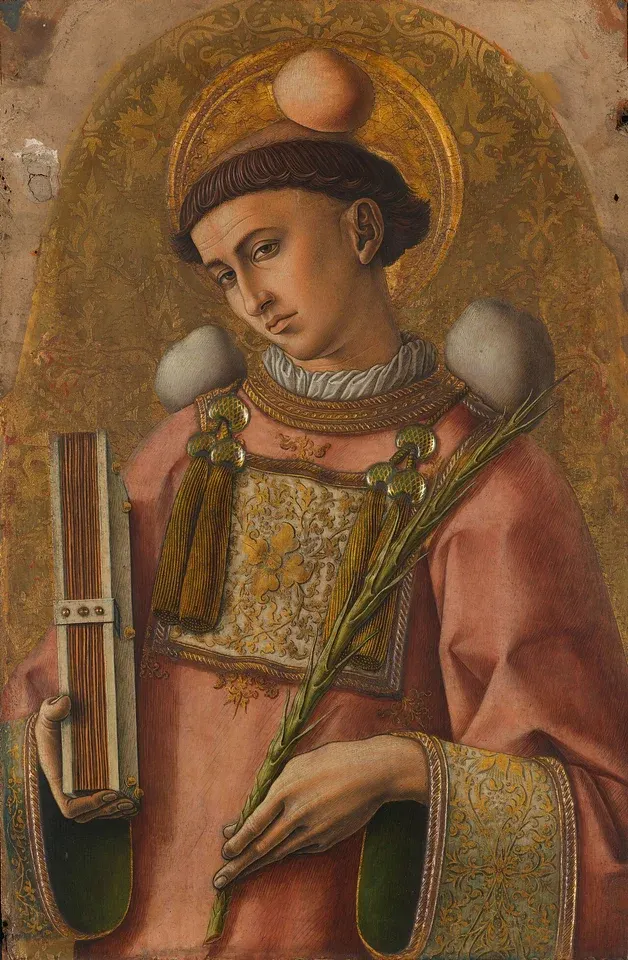
Biography
Stephen appears in the Acts of the Apostles among seven men chosen to help meet the needs of the early Christian community. Traditionally counted among the first deacons, he is described as a powerful witness whose preaching brought him into conflict with opponents. Acts records his defense before the council and his death by stoning.
His defense retells Israel’s story as the setting for the coming of Jesus. Acts presents his witness as both service and proclamation: he helps the community and publicly explains its faith. The lengthy speech leads to the vision of the risen Christ that intensifies his opponents’ anger.
Christian artists often identify him through stones or the palm associated with martyrdom. His final prayer deliberately recalls Jesus’ own forgiveness of his executioners. The narrative asks readers to consider how a disciple bears hostility without answering it with hatred, even when faithfulness becomes costly.
The account emphasizes his vision of Christ and his prayer for those killing him. Saul, later known as Paul, is named among those approving the execution. Stephen is remembered as the first Christian martyr, and his feast immediately after Christmas connects the birth of Christ with the costly witness of discipleship.
Context & contribution
A speech that interprets a whole history
Stephen’s defense in Acts is much more than a brief refusal to abandon his faith. It retells the history of God’s dealings with Israel and places the conflict over Jesus within that story. The speech is therefore part of the theological argument of Acts, not merely a transcript-like interruption before the martyrdom.
The final prayer for his killers also connects his witness with Jesus’ Passion. Readers should attend to that connection rather than turning the episode into blame against Jewish people collectively. Stephen and the earliest Christian community belong within a Jewish setting; the narrative concerns a particular conflict and its Christian interpretation.
Explore the sources for this section
AI-assisted source comparison updated 2026-09-26. Editorial approach
From the Saint Discovery blog
Keep exploring your faith
Practical guides to prayer, the saints, and living the Catholic faith.
Why Is St. Thérèse the Patron Saint of Missions?
Why is St. Thérèse patron saint of missions? Discover her support for missionaries and practical ways to participate in the Church's mission from home.
Sharing the faithRead the article Everyday faithWhat Is Evangelization? A Catholic Guide to Sharing the Faith
What is evangelization? Learn the Catholic meaning, the new evangelization, and practical ways to share your faith with respect, confidence, and love.
Sharing the faithRead the articleFrom reading to reflection
What will you carry with you?
After reading about St. Stephen, take a moment to consider:
- Read the beginning and ending of Stephen’s speech in Acts 7. How does the historical retelling prepare for his final testimony?
These are reflection prompts from Saint Discovery, not quotations from the saint.
Sources and further reading
Biography source comparison recorded on . This is an AI-assisted comparison, not independent human or ecclesiastical approval.
What the recorded review covers
AI-assisted expansion using the linked historical and ecclesiastical sources; devotional traditions distinguished from documented history.
A source list helps you check an account; it does not establish that every claim is certain. Follow the biography’s qualifications about historical evidence, traditions and feast calendars.
Suggest a correction to this biography
How we research these pages and handle corrections · Directory corrections log
More lives to explore
Suggestions based on the site’s quiz themes, not a historical relationship or a measure of holiness.