Catholic saint biography
St. Marianne Cope
- Commemoration:
- January 23
- Lived:
- 1838–1918 — Germany; New York and Hawaii
United States memorial, on her birthday.
Why dates and liturgical observances can differ
Read the sources for this biography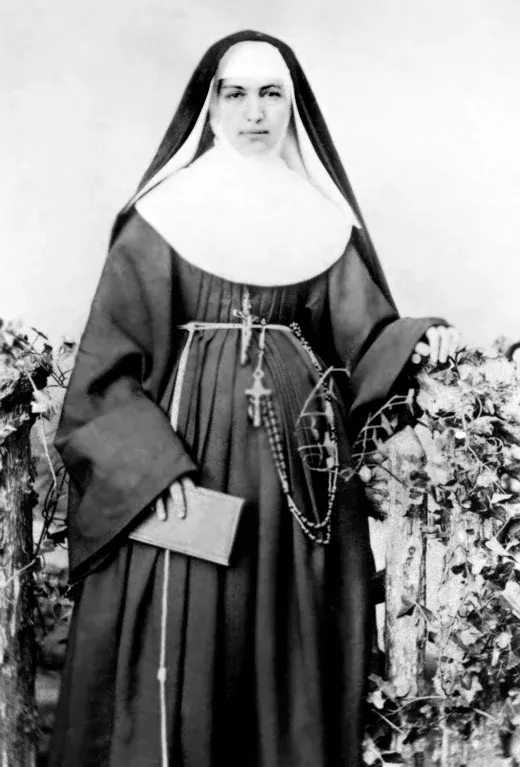
Biography
Marianne Cope was born Barbara Koob in Germany and grew up in New York after her family's migration. She worked to support relatives before entering the Sisters of Saint Francis in Syracuse. Her early religious service included teaching and hospital administration, where she emphasized care for patients who were often excluded.
As the oldest child at home, she spent years in factory work when her father became ill. Entry into religious life at twenty-four followed that period of family support. Teaching and governance in New York then gave her experience in organizing institutions before she accepted the invitation to Hawaii.
In 1883 she led sisters to Hawaii to assist people with Hansen's disease. Her ministry eventually brought her to Kalaupapa on Molokai, where she provided care and helped improve daily life for residents. She remained in Hawaii until her death in 1918. Canonized in 2012, she is commemorated in the United States on January 23.
Hospital administration taught her to combine compassion with the practical demands of reliable care. At Kalaupapa, isolation imposed on people with Hansen's disease made housing, education, and ordinary dignity inseparable from nursing. Her decades there are a history of sustained service, not only a brief encounter with a famous mission.
Context & contribution
Caring for the children affected by exclusion
In Honolulu the sisters' responsibility at Kaka'ako extended to the healthy children of people with Hansen's disease. In 1885 they established the Kapi'olani Home for daughters whose family connection to patients made others unwilling to care for them. Stigma was affecting children who did not have the disease, creating needs that a hospital ward alone could not address.
A change of government policy in 1887 closed the Oahu receiving hospital and renewed enforced isolation at Molokai. Marianne's subsequent move therefore responded to a political decision as well as a medical need. Her work helps reveal how family separation, public policy, and fear shaped the lives of patients and their children.
Explore the sources for this section
AI-assisted source comparison updated 2026-09-26. Editorial approach
From the Saint Discovery blog
Keep exploring your faith
Practical guides to prayer, the saints, and living the Catholic faith.
St. Josephine Bakhita: Hope Without Denying Suffering
Learn what St. Josephine Bakhita teaches about Christian hope, dignity, and freedom, with practical reflection prompts and an original prayer.
Faith in difficult timesRead the article Prayer & reflectionWhat Is Redemptive Suffering? A Catholic Guide
What is redemptive suffering? Learn what Catholics mean by offering it up, how to unite suffering to Christ, and why seeking help belongs with faith.
Faith in difficult timesRead the articleFrom reading to reflection
What will you carry with you?
After reading about St. Marianne Cope, take a moment to consider:
- Compare the needs served by Kaka'ako Hospital and the Kapi'olani Home; identify which arose from illness and which from social exclusion.
These are reflection prompts from Saint Discovery, not quotations from the saint.
Sources and further reading
Biography source comparison recorded on . This is an AI-assisted comparison, not independent human or ecclesiastical approval.
What the recorded review covers
AI-assisted expansion of the existing source-reviewed biography with comparison to retrieved cited sources; not ecclesiastical approval
A source list helps you check an account; it does not establish that every claim is certain. Follow the biography’s qualifications about historical evidence, traditions and feast calendars.
Suggest a correction to this biography
How we research these pages and handle corrections · Directory corrections log
More lives to explore
Suggestions based on the site’s quiz themes, not a historical relationship or a measure of holiness.