Catholic saint biography
St. John Paul II
- Commemoration:
- October 22
- Lived:
- 1920–2005 — Wadowice, Poland
Roman optional memorial, marking the inauguration of his pontificate.
Why dates and liturgical observances can differ
Read the sources for this biography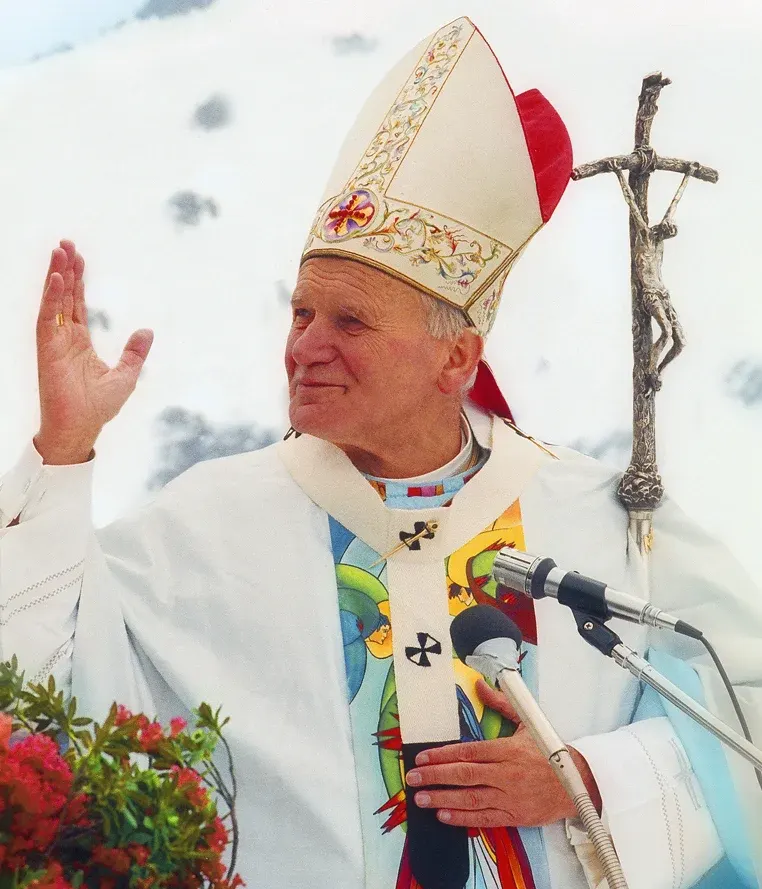
Biography
Karol Wojtyła grew up in Poland and pursued university studies and theater before the Nazi occupation interrupted his plans. He worked as a laborer and studied for the priesthood clandestinely. Later bishop and archbishop of Kraków, he participated in the Second Vatican Council before his election as pope in 1978.
Wartime work in a quarry and chemical factory supported him after the university was closed. His clandestine seminary formation took place alongside involvement in underground theater. Ordained in 1946, he continued studying in Rome and later taught ethics and theology, bringing philosophical training into his pastoral and episcopal responsibilities.
John Paul II's long pontificate included extensive international travel, the establishment of World Youth Day, major teaching documents, and the publication of the Catechism of the Catholic Church. He promoted dialogue with other Christians and religions while maintaining strong positions on Catholic doctrine. He died in 2005 and was canonized in 2014. His liturgical memorial marks his inaugural Mass rather than his death.
His election brought a Polish pastor shaped by occupation and communist rule to the papacy. Travel, encounters with young people, and sustained teaching became characteristic expressions of his ministry. The scale of his pontificate requires attention to particular events and documents rather than treating every development in the Church during those years as his personal achievement.
As a young priest he developed close relationships with students, accompanying them on outdoor trips as well as in worship and discussion. During his ministry in Krakow, the planned workers' district of Nowa Huta became a particularly significant setting: celebrating Christmas Mass there expressed the needs of a community denied a church building. Such experiences connected religious freedom with the everyday lives of families and workers.
An assassination attempt in Saint Peter's Square on May 13, 1981, seriously wounded him. After recovering, he visited the imprisoned attacker and offered forgiveness. In later years Parkinson's disease increasingly limited his movement and speech. His public ministry consequently included both the vigorous travel of his earlier pontificate and the visible limitations of serious illness, with his final years drawing attention to care for people who are frail or dependent.
Context & contribution
A pontificate expressed in law and literature
John Paul II promulgated codes of canon law for both the Latin Church and the Eastern Catholic Churches. The Holy See's biography places these legal projects beside the Catechism, revealing a less visible side of a pope often remembered through journeys: institutions also required coherent rules and reference works to carry the council's renewal into ordinary governance.
His published books range from autobiographical reflection to the poetry of Roman Triptych. These genres should be distinguished from encyclicals and other official teaching documents. A poem, a personal recollection, and a legislative act do different kinds of work; reading them as interchangeable statements of authority obscures both his literary interests and the nature of papal teaching.
Explore the sources for this section
AI-assisted source comparison updated 2026-09-26. Editorial approach
From the Saint Discovery blog
Keep exploring your faith
Practical guides to prayer, the saints, and living the Catholic faith.
What Is the Domestic Church? John Paul II on Faith at Home
What Catholics mean by the domestic church, how John Paul II explained family life, and practical ways to begin with prayer, forgiveness and welcome.
Connected to this saintRead the article Prayer & reflectionWhy Do Catholics Pray to Saints? Intercession Explained
Why do Catholics pray to saints? Learn how intercession differs from worship, how it relates to Jesus, and a simple way to ask a saint to pray for you.
A next step with your saintRead the articleFrom reading to reflection
What will you carry with you?
After reading about St. John Paul II, take a moment to consider:
- Classify Roman Triptych, a papal encyclical, and a canon-law code by genre; describe what question each can answer and what it cannot.
These are reflection prompts from Saint Discovery, not quotations from the saint.
History, tradition & the calendar
Reading the evidence
The Holy See's biographical record supports dates and events in John Paul II's life. Assessments of the effects of his pontificate require additional evidence and should not be treated as automatically established by that biography. His poetry, personal recollections, legislation, and formal teaching documents also have different purposes and authority.
Understanding the commemoration
The USCCB identifies October 22 as an optional memorial, following its inclusion in the General Roman Calendar in 2014. This date recalls the inauguration of his pontificate; he died on April 2, 2005. An optional memorial is a different liturgical rank from a feast, even though everyday usage often calls both a saint's feast day.
These notes were compared with the linked sources on 2026-10-03 using AI assistance.
Sources and further reading
Biography source comparison recorded on . This is an AI-assisted comparison, not independent human or ecclesiastical approval.
What the recorded review covers
AI-assisted expansion of the existing source-reviewed biography with comparison to retrieved cited sources; not ecclesiastical approval
A source list helps you check an account; it does not establish that every claim is certain. Follow the biography’s qualifications about historical evidence, traditions and feast calendars.
Suggest a correction to this biography
How we research these pages and handle corrections · Directory corrections log
Editorial updates
· Clarification
Explained John Paul II's optional memorial and anniversary choice
Added a USCCB reference explaining the optional memorial's rank, its inclusion in the General Roman Calendar, and its distinction from his April 2 death anniversary.
Read the change record →
More lives to explore
Suggestions based on the site’s quiz themes, not a historical relationship or a measure of holiness.