Catholic saint biography
St. Andrew the Apostle
- Commemoration:
- November 30
- Lived:
- First century — Bethsaida in Galilee
Why dates and liturgical observances can differ
Read the sources for this biography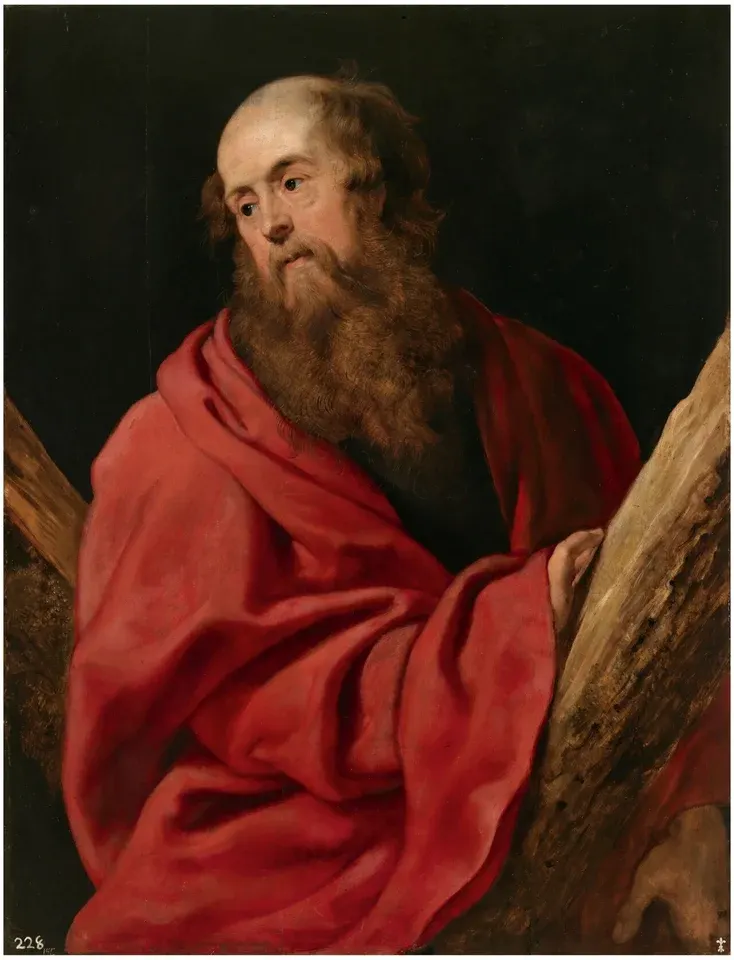
Biography
Andrew was one of Jesus's twelve apostles, a fisherman from Bethsaida, and the brother of Simon Peter. John's Gospel gives him a distinctive role in introducing other people to Jesus, beginning with his own brother.
Initially associated with John the Baptist, Andrew followed Jesus after hearing John's testimony. The Gospel account then describes him bringing Simon to meet the person he had recognized as the Messiah. His role is personal and relational rather than one defined by long recorded speeches.
Other passages show Andrew drawing attention to a boy with loaves and fish before the feeding of the crowd and helping Greek visitors who wished to see Jesus. Acts places him among the apostles gathered in Jerusalem after the Ascension. These scriptural scenes provide the clearest basis for his biography.
The New Testament does not describe his death. Accounts of missions around the Black Sea and martyrdom at Patras belong to subsequent Christian tradition. The diagonal cross familiar in his art is part of that devotional history, not an eyewitness detail supplied by the Gospels. His November 30 feast honors an apostle remembered for responding to Jesus and bringing others into that encounter.
Context & contribution
Seeing what is present before a sign
In John 6, Philip calculates the expense of feeding the crowd, while Andrew notices the boy's barley loaves and fish. Andrew does not claim to have solved the problem; his question makes the inadequacy of the available food explicit. The scene presents observation and uncertainty together.
The narrative then moves from scarcity to a shared meal and the gathering of leftovers. Andrew's small intervention belongs inside that larger theological sign, which leads into the chapter's teaching about the bread of life. Reading the whole passage prevents his role from becoming merely a lesson about resourcefulness: he helps bring an actual human situation into the encounter with Jesus.
Explore the sources for this section
AI-assisted source comparison updated 2026-09-26. Editorial approach
From the Saint Discovery blog
Keep exploring your faith
Practical guides to prayer, the saints, and living the Catholic faith.
Why Is Saint Luke's Symbol an Ox? Meaning and Biblical Roots
Discover why Saint Luke's symbol is a winged ox, its biblical roots, and how the image connects his Gospel with priesthood and sacrifice.
Go deeper into ScriptureRead the article Prayer & reflectionHow to Pray the Jesus Prayer: A Catholic Beginner's Guide
Learn the Jesus Prayer, its Eastern Christian roots and biblical meaning, with a simple Catholic practice focused on Christ and mercy.
Go deeper into ScriptureRead the articleFrom reading to reflection
What will you carry with you?
After reading about St. Andrew the Apostle, take a moment to consider:
- Read John 6:5–13 and compare Philip's calculation with Andrew's observation. What does each contribute before Jesus acts?
These are reflection prompts from Saint Discovery, not quotations from the saint.
Sources and further reading
Biography source comparison recorded on . This is an AI-assisted comparison, not independent human or ecclesiastical approval.
What the recorded review covers
AI-assisted expansion checked against retrieved historical and institutional sources; traditions distinguished from documented history; not ecclesiastical approval
A source list helps you check an account; it does not establish that every claim is certain. Follow the biography’s qualifications about historical evidence, traditions and feast calendars.
Suggest a correction to this biography
How we research these pages and handle corrections · Directory corrections log
More lives to explore
Suggestions based on the site’s quiz themes, not a historical relationship or a measure of holiness.