02 · Reflect
A question to sit with
What have you received that you can share? Consider a gift of time, skill, encouragement, or material help.
What detail in St. Ephrem the Syrian’s story invites you to think differently about your own day?
Choose your language
Automatic translation by Google. Wording may be imperfect. Email forms stay on the English site.
Opens this public page in Google Translate. About translation ↗
A little time for faith, every day
Read a life. Make space for prayer. Carry one good thing into your day.
June 9From the feast-day calendar
01 · Read · A life to discover
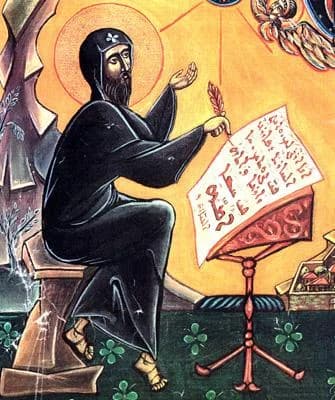
Ephrem was a fourth-century Syriac-speaking deacon, teacher, and poet whose hymns made theology part of communal worship. Associated with Nisibis and later Edessa, he represents Christianity's early development beyond the Greek and Latin worlds.
Born around 306, he grew up under the influence of Bishop James of Nisibis and worked in the city's Christian community. When Nisibis passed to Persian control in 363, he moved to Edessa, carrying his teaching and literary activity into a new setting.
His writings include prose commentary, verse homilies, and hymns. He used images of light, fire, food, gardens, and precious stones to explore creation, Christ's incarnation, Mary, and the Eucharist. These were not simply ornaments added to arguments: poetry itself became a way of teaching.
Ephrem remained a deacon rather than becoming a priest or bishop. He died in 373; church tradition associates his final illness with service to sick people. Known as the Harp of the Holy Spirit, he is honored in Eastern Christianity and as a Catholic Doctor of the Church. His work shows how music and biblical interpretation shaped the understanding of entire communities.
This saint is included on this recurring date in the U.S. Roman Rite calendar published by the USCCB. This reading guide gives U.S. calendar saints priority; the Mass celebrated on a particular year’s date can differ because of Sundays, seasons or higher-ranking celebrations.
Explore the biography & sourcesWhen several saints share a date, this guide first favors saints on the USCCB’s U.S. calendar, then other documented Catholic commemorations. Dates can vary by place and tradition. This is a discovery guide, not the official liturgical calendar for your parish; the liturgical banner follows the celebration for the year. The date browser includes February 29 for leap years.
Bring it into your day
Original reflections and prayer prompts from Saint Discovery, not words attributed to St. Ephrem the Syrian.
02 · Reflect
What have you received that you can share? Consider a gift of time, skill, encouragement, or material help.
What detail in St. Ephrem the Syrian’s story invites you to think differently about your own day?
03 · Pray
God of all goodness, thank you for the gifts I receive. Open my hands and my heart so that I may share them freely. Amen.
Take a moment to add your own intention.
04 · Act
Thank someone specifically, then find one practical way to help another person.
Optional check-in for this visit. Nothing is saved or sent.
0 of 4 moments completed
More lives to explore
Let this become a small habit
Bookmark this daily page to return. Or keep exploring a saint whose life speaks to yours.