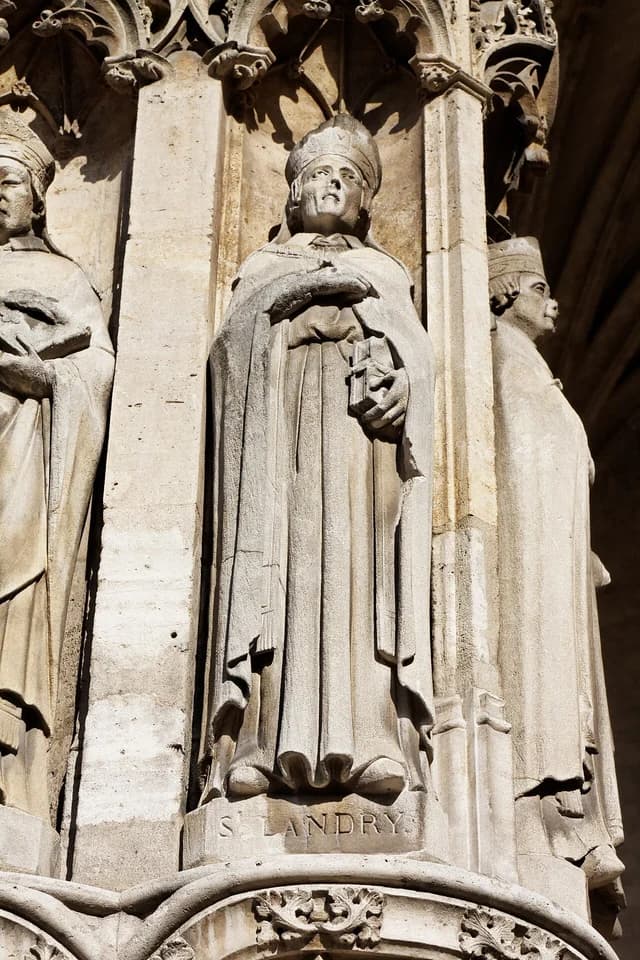
01 · Read · A life to discover
St. Landry of Paris
Landry was bishop of Paris in the middle of the seventh century. The diocesan tradition remembers an administrator whose concern for the poor became especially visible during famine. He is said to have sold furnishings and church vessels to provide food, putting immediate human need ahead of the preservation of valuable objects.
The famine story is remembered because it presents a clear choice about the use of church property. Precious objects were to serve people rather than become an end in themselves. As an account transmitted through local tradition, it explains his reputation for charity without supplying an exact financial record of the relief effort.
Paris also associates him with the beginnings of the Hôtel-Dieu, where care for sick and destitute people could be offered beyond the bishop's household. The precise details of this foundation remain partly traditional, while a document bearing his signature survives from 654. His burial and later veneration at Saint-Germain-l'Auxerrois made him an enduring local figure of episcopal charity and organized care.
His Parisian cult remained attached to identifiable places. At Saint-Germain-l'Auxerrois, imagery of a book and a hand placed near the heart joins learning with concern for the poor. The signed document anchors him in seventh-century history even where the later hospital foundation narrative cannot be established in every detail.
Optional memorial in the Diocese of Paris on June 10.
Explore the biography & sources ↗