02 · Reflect
A question to sit with
What have you received that you can share? Consider a gift of time, skill, encouragement, or material help.
What detail in St. Cyril and Methodius’s story invites you to think differently about your own day?
Choose your language
Automatic translation by Google. Wording may be imperfect. Email forms stay on the English site.
Opens this public page in Google Translate. About translation ↗
A little time for faith, every day
Read a life. Make space for prayer. Carry one good thing into your day.
February 14From the feast-day calendar
01 · Read · A life to discover
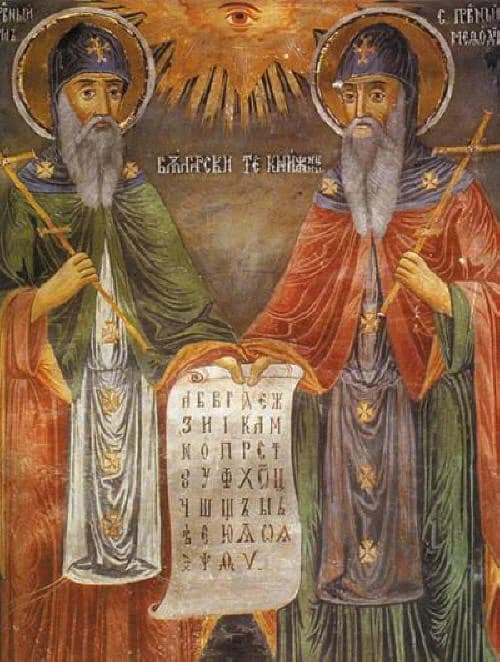
Cyril and Methodius were brothers from Thessalonica who brought Christian teaching and worship to Slavic-speaking peoples. Their mission to Great Moravia involved translating Scripture and liturgical texts into Slavonic. Cyril devised the Glagolitic script to serve that work; the later Cyrillic alphabet developed among their successors.
The brothers came from Thessalonica and brought different experience to their shared mission. Cyril, originally Constantine, received an advanced education in Constantinople; Methodius had administrative experience before becoming a monk. An earlier embassy to the Khazars also exposed them to religious discussion beyond the Byzantine Christian world.
Their Moravian work answered a request for teachers able to explain Christianity in the people’s own language. Cyril developed the Glagolitic alphabet to support translation; the later Cyrillic alphabet should not simply be treated as his personal invention. Their achievements involved language, education, worship, and contested church authority together.
Their use of a local language met resistance from clergy who defended established Latin practice. They sought support in Rome, where Cyril became a monk and died in 869. Methodius returned to the mission as a bishop and continued despite imprisonment and political opposition. Their legacy links evangelization with translation and cultural understanding. They are Catholic co-patrons of Europe.
This saint is included on this recurring date in the U.S. Roman Rite calendar published by the USCCB. This reading guide gives U.S. calendar saints priority; the Mass celebrated on a particular year’s date can differ because of Sundays, seasons or higher-ranking celebrations.
Explore the biography & sourcesWhen several saints share a date, this guide first favors saints on the USCCB’s U.S. calendar, then other documented Catholic commemorations. Dates can vary by place and tradition. This is a discovery guide, not the official liturgical calendar for your parish; the liturgical banner follows the celebration for the year. The date browser includes February 29 for leap years.
Bring it into your day
Original reflections and prayer prompts from Saint Discovery, not words attributed to St. Cyril and Methodius.
02 · Reflect
What have you received that you can share? Consider a gift of time, skill, encouragement, or material help.
What detail in St. Cyril and Methodius’s story invites you to think differently about your own day?
03 · Pray
God of all goodness, thank you for the gifts I receive. Open my hands and my heart so that I may share them freely. Amen.
Take a moment to add your own intention.
04 · Act
Thank someone specifically, then find one practical way to help another person.
Optional check-in for this visit. Nothing is saved or sent.
0 of 4 moments completed
More lives to explore
Let this become a small habit
Bookmark this daily page to return. Or keep exploring a saint whose life speaks to yours.