Saint Hedwig of Silesia and Saint Jadwiga of Poland are two different women, not two names for the same saint. The duchess of Silesia died in 1243; the later queen of Poland died in 1399. Our biographies of Hedwig of Silesia and Jadwiga of Poland follow their separate lives.
The confusion is understandable. Hedwig and Jadwiga are forms of the same given name, and both women belong to the history of the Church in Poland. If you found a prayer card, a parish named Saint Hedwig, or an October calendar entry, the name alone may leave you wondering whose story you are reading. A few details make the distinction much easier.
Why the name alone is not enough
An English account may call the queen Hedwig, while another calls her Jadwiga. The Vatican's English text for her canonization uses Hedwig; the French bishops' Nominis site calls her Hedwige and explicitly links to a separate duchess of Silesia with the same name. These are spelling differences across languages, not evidence that the two biographies should be combined. See Nominis's entry for the queen.
Keep the place or title attached when taking notes: Hedwig of Silesia, the duchess, and Jadwiga of Poland, the queen. That small habit prevents a report, family conversation, or parish handout from giving one woman the other's husband, dates, or achievements.
Hedwig of Silesia: the duchess remembered on October 16
Hedwig of Silesia lived from about 1174 to 1243. Born into the Andechs family in Bavaria, she married Henry, Duke of Lower Silesia. Together they supported hospitals, churches, and monasteries, including the Cistercian foundation at Trebnitz in 1202. After Henry's death, she lived at Trebnitz while continuing her charitable work. The Basilica of the National Shrine's account describes these foundations and her care for people in poverty.
Vatican News records her death on October 15, 1243, and her canonization by Pope Clement IV in 1267. Its short biography of the duchess also emphasizes prayer, generosity, and endurance through family losses.
In the United States liturgical calendar, October 16 is her optional memorial. The day of death and the calendar observance are therefore different dates. Optional memorial also has a particular liturgical meaning; it does not mean every parish must celebrate the observance. Our explanation of solemnities, feasts, and memorials can help you read that calendar language.
Jadwiga of Poland: the later queen associated with Krakow
The queen lived from 1374 to 1399, well after the duchess. Nominis identifies her as born in Hungary and married to Jogaila, the Lithuanian ruler known after baptism as Wladyslaw. Its entry lists July 17; that listing should not be confused with the duchess's October optional memorial or treated as proof that every local calendar uses the same observance.
John Paul II canonized the queen in Krakow on June 8, 1997. In his canonization homily, he recalled her contribution to Lithuania's evangelization, her support for learning, and her service to those entrusted to her. He particularly connected her generosity with the theological faculty and renewal of the University of Krakow.
That educational legacy is a useful identifying detail. An account about the queen's support for Krakow's university belongs to Jadwiga's story; the earlier Cistercian foundation at Trebnitz belongs to the duchess's.
How to identify the saint on a card or church sign
Start with the century. A death date of 1243 points to the duchess; 1399 points to the queen. Next look for the spouse: Henry for Hedwig of Silesia, Jogaila or Wladyslaw Jagiello for Jadwiga of Poland. Finally, look for a specific place or institution, such as Trebnitz or Krakow's university.
If an item gives only Saint Hedwig, leave the identification open until you find another clue. For a parish, its own history or patronal celebration is a better next stop than guessing from the name. For a borrowed picture, read the original caption before attaching a biography.
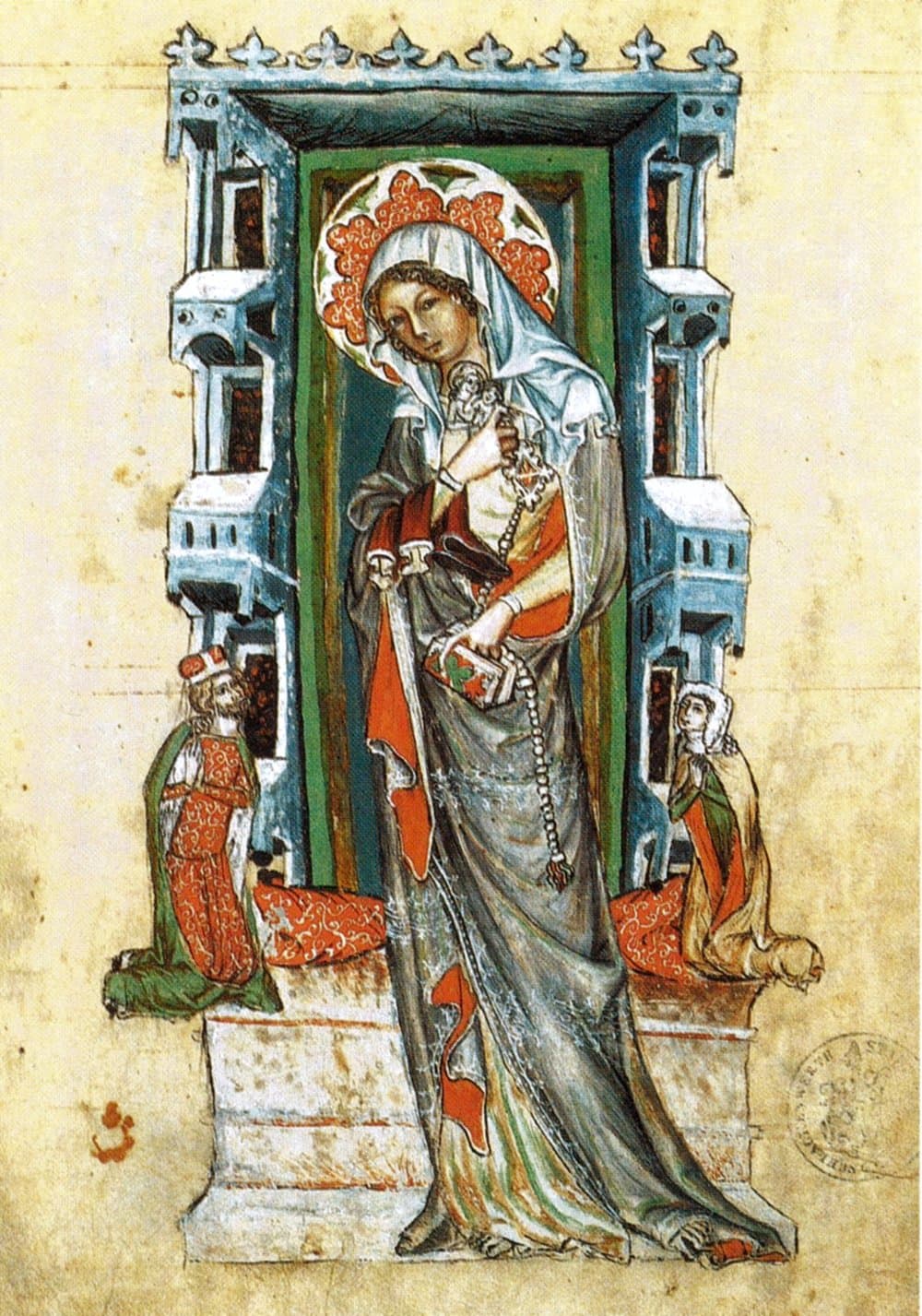
The cover here depicts the duchess. It is a 1353 miniature, identified on its Wikimedia Commons file page, with Saint Hedwig standing between two kneeling figures. It is devotional artwork, not a photograph or a likeness documented from life.

Choosing Hedwig or Jadwiga as a Confirmation saint
If either woman interests you as a Confirmation patron, begin with one clearly identified biography. Write the full name at the top of your notes, then choose one documented part of her life to explore. You do not need to combine both lives to find a meaningful example.
These are original reflection suggestions: with the duchess, consider how regular generosity might fit your actual household responsibilities. With the queen, consider how your education could become service to someone else. A practical response could be a recurring hour of help, a modest gift you can sustain, or patient tutoring rather than a large promise you cannot keep.
Use the Confirmation saint guide to connect that reflection with your parish's preparation process. When discussing your choice with a sponsor or catechist, give the saint's full name and explain the particular example you hope to follow. The shared name can begin your interest; learning whose life you mean lets that interest grow into something more personal.