Catholic saint biography
St. Nino of Georgia
- Commemoration:
- January 14
- Lived:
- Fourth century — Cappadocia and ancient Iberia, according to tradition
Orthodox date; Julian January 14 corresponds to civil January 27. Western tradition also remembers her as Christina on December 15.
Why dates and liturgical observances can differ
Read the sources for this biography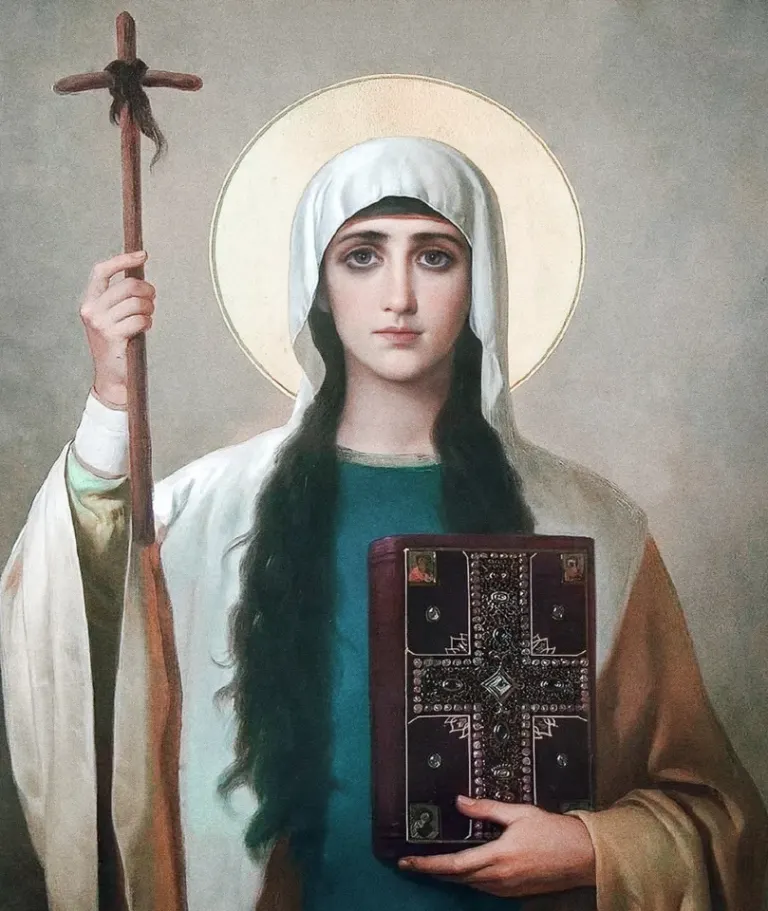
Biography
Nino, also called Nina, is honored as the woman whose Christian witness helped bring ancient Iberia, in present-day Georgia, to Christianity. Orthodox tradition calls her Equal to the Apostles, recognizing the enduring importance of her missionary role.
The early account concerns a captive Christian woman whose prayers and way of life attracted attention. Georgian tradition names her Nino and places her preaching at Mtskheta. The conversion of Queen Nana and King Mirian became central to the story of the Georgian Church's beginnings.
Later devotional narratives supply a much fuller life, including journeys, visions, miraculous healings, and family connections. These details are not all contemporary evidence. One especially influential tradition describes a grapevine cross bound with hair, explaining the distinctive cross associated with her in Georgian religious art.
Her burial is associated with Bodbe, where her memory has remained a focus of devotion. The Orthodox calendar cited here commemorates her on January 14. Reading her life responsibly means preserving both her foundational place in Georgian Christianity and the distinction between early testimony and the fuller sacred narratives that developed around it.
Context & contribution
Reading the beginnings of Georgian Christianity
The Orthodox account moves between royal conversions and encounters with ordinary households. Before its scenes involving Queen Nana and King Mirian, it places Nino with a gardener’s family. Within that religious narrative, the spread of belief begins through hospitality, prayer, and personal relationships before it becomes a royal undertaking.
This distinction helps readers understand the title Equal to the Apostles. It expresses the Church’s assessment of her missionary importance, rather than claiming that she belonged to the New Testament group of Twelve. The visions and miraculous episodes in the account should be read as elements of Georgian sacred tradition, not as independently verified stages of a travel diary.
Explore the sources for this section
AI-assisted source comparison updated 2026-09-26. Editorial approach
From the Saint Discovery blog
Keep exploring your faith
Practical guides to prayer, the saints, and living the Catholic faith.
Why Is St. Thérèse the Patron Saint of Missions?
Why is St. Thérèse patron saint of missions? Discover her support for missionaries and practical ways to participate in the Church's mission from home.
Sharing the faithRead the article Everyday faithWhat Is Evangelization? A Catholic Guide to Sharing the Faith
What is evangelization? Learn the Catholic meaning, the new evangelization, and practical ways to share your faith with respect, confidence, and love.
Sharing the faithRead the articleFrom reading to reflection
What will you carry with you?
After reading about St. Nino of Georgia, take a moment to consider:
- Compare the household and royal scenes in the cited account. How does each explain the spread of faith, and which details does the narrative present through miracles?
These are reflection prompts from Saint Discovery, not quotations from the saint.
Sources and further reading
Biography source comparison recorded on . This is an AI-assisted comparison, not independent human or ecclesiastical approval.
What the recorded review covers
AI-assisted expansion using the linked historical and ecclesiastical sources; devotional traditions distinguished from documented history.
A source list helps you check an account; it does not establish that every claim is certain. Follow the biography’s qualifications about historical evidence, traditions and feast calendars.
Suggest a correction to this biography
How we research these pages and handle corrections · Directory corrections log
More lives to explore
Suggestions based on the site’s quiz themes, not a historical relationship or a measure of holiness.