Catholic saint biography
St. Lucy of Syracuse
- Commemoration:
- December 13
- Lived:
- Died about 304 — Syracuse, Sicily
Why dates and liturgical observances can differ
Read the sources for this biography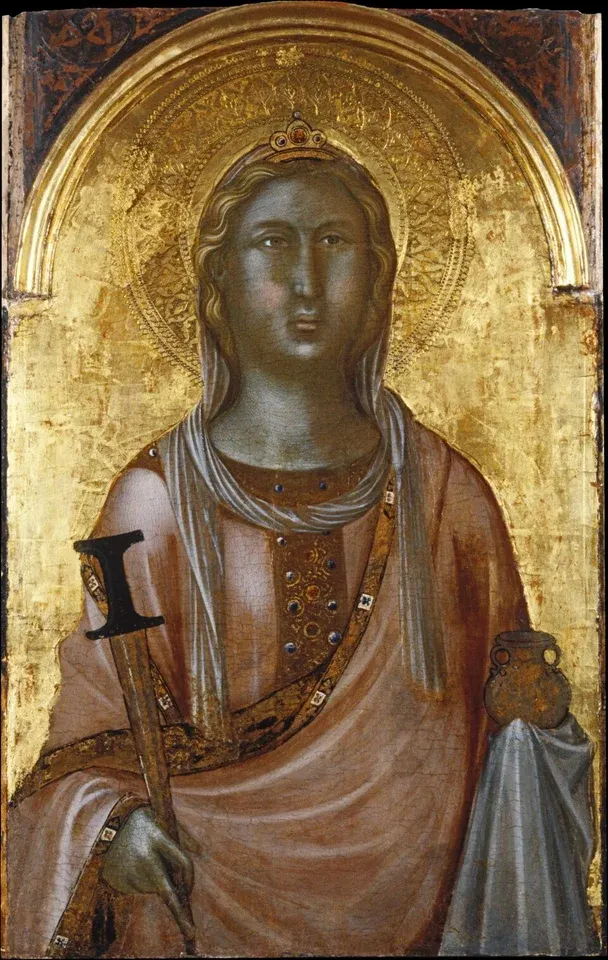
Biography
Lucy is an early Christian martyr associated with Syracuse in Sicily. Her ancient veneration is better established than the detailed stories of her life: she appears in early liturgical tradition and among the women remembered in the Roman Canon. Christians in East and West have long celebrated her on December 13.
The familiar narrative links her proposed gift of property with opposition from a disappointed suitor. It also connects her story with devotion to Agatha at Catania. These relationships are part of the later literary account, not independently preserved records of her household or legal proceedings.
Later accounts describe a young woman who dedicated herself to God, gave resources to poor people, and was denounced during persecution. These narratives contain miraculous episodes and conventional elements shared with other martyr stories. They should be read as hagiography rather than a contemporary trial record. Her enduring commemoration preserves the memory of a Christian woman who died for her faith.
Her place in worship gives a different kind of evidence. Inclusion in ancient prayer and the continuing December commemoration show how early and widely Christians honored her. That enduring liturgical memory can be affirmed while allowing uncertainty about dramatic episodes that developed around the historical martyr of Syracuse.
Context & contribution
An inscription that anchors early devotion
The inscription of Euskia, discovered by Paolo Orsi in Syracuse's catacombs of San Giovanni in 1894, provides material evidence for Lucy's early cult. The diocesan history identifies it as an especially important witness to her remembrance. A funerary inscription mentioning a saint's feast differs fundamentally from a later narrative of miraculous events.
The inscription can support the antiquity of local devotion without confirming every detail of Lucy's trial or family life. It also shows how one person's burial record can illuminate the religious calendar of a wider community. Lucy's history is therefore studied not only through saints' lives, but through archaeology and the ordinary memorial practices of Syracusan Christians.
Explore the sources for this section
AI-assisted source comparison updated 2026-09-26. Editorial approach
From the Saint Discovery blog
Keep exploring your faith
Practical guides to prayer, the saints, and living the Catholic faith.
Why Do Catholics Pray to Saints? Intercession Explained
Why do Catholics pray to saints? Learn how intercession differs from worship, how it relates to Jesus, and a simple way to ask a saint to pray for you.
A next step with your saintRead the article Living the seasonsHow to Celebrate Your Patron Saint's Feast Day at Home
Celebrate your patron saint's feast day with prayer, a short biography, and an act of kindness. A practical plan for families, sponsors, and individuals.
A next step with your saintRead the articleFrom reading to reflection
What will you carry with you?
After reading about St. Lucy of Syracuse, take a moment to consider:
- Explain what an inscription saying someone died on Lucy's feast establishes—and what it leaves unknown—about the martyr's life.
These are reflection prompts from Saint Discovery, not quotations from the saint.
Sources and further reading
Biography source comparison recorded on . This is an AI-assisted comparison, not independent human or ecclesiastical approval.
What the recorded review covers
AI-assisted expansion of the existing source-reviewed biography with comparison to retrieved cited sources; not ecclesiastical approval
A source list helps you check an account; it does not establish that every claim is certain. Follow the biography’s qualifications about historical evidence, traditions and feast calendars.
Suggest a correction to this biography
How we research these pages and handle corrections · Directory corrections log
More lives to explore
Suggestions based on the site’s quiz themes, not a historical relationship or a measure of holiness.