01 · Read · A life to discover
St. Hildegard of Bingen
Hildegard of Bingen (1098–1179) was a Benedictine abbess whose work joined theology, music, community leadership, and the study of creation. Her surviving writings make it possible to encounter a medieval woman through more than later stories about her. They also require attention to the religious world in which she wrote.
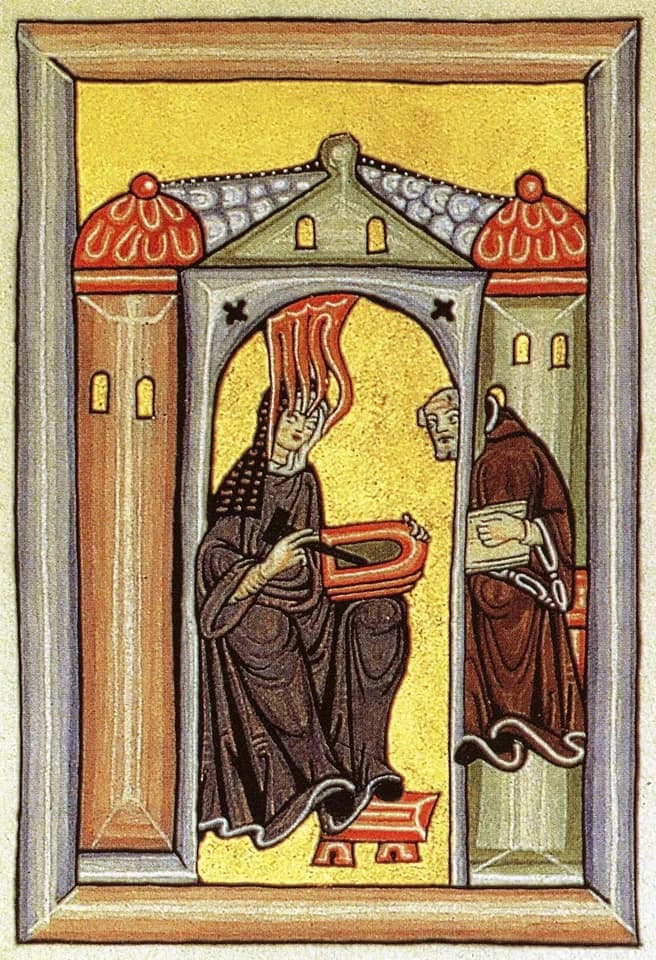
Formed in religious life under Jutta at Disibodenberg, Hildegard became leader of the women’s community after Jutta’s death in 1136. When she began recording her visions, she sought advice rather than presenting them as beyond examination. Her correspondents included Bernard of Clairvaux. Pope Eugene III encountered her work at the Synod of Trier in 1147 and authorized her to write and speak about her experiences. Her writings were produced with assistance, including that of the monk Volmar. These relationships place her visionary accounts within a community of readers and religious authorities.
Her three major visionary works have different emphases. Scivias presents the story of salvation through symbolic visions. The Book of Life’s Merits explores the struggle between virtues and vices. The Book of Divine Works considers creation and humanity in relation to God, with Christ at its center. These are theological works shaped by Scripture and rich imagery. Hildegard also composed sacred songs. Her correspondence extended beyond the monastery: she challenged religious and political leaders, including Emperor Frederick Barbarossa, when she believed their conduct harmed the Church.
Leadership required buildings, journeys, and the daily care of sisters as well as writing. Around 1150, Hildegard moved her community to Rupertsberg near Bingen; in 1165 she established another house at Eibingen, while remaining responsible for both. She undertook preaching journeys and left letters, sermons, music, and writings on nature. The range is striking, but these works should be read in their historical setting. Her medieval accounts of health are not clinical evidence for using a remedy today.
Benedict XVI declared her a Doctor of the Church on October 7, 2012, recognizing the importance of her spiritual teaching. That recognition invites study of her understanding of God, humanity, and creation. It does not turn every medieval description of the natural world into a modern scientific conclusion. For a first encounter, her theological works and music provide a clearer starting point than claims that isolate a supposed cure or prediction from its original context.
This saint is included on this recurring date in the U.S. Roman Rite calendar published by the USCCB. This reading guide gives U.S. calendar saints priority; the Mass celebrated on a particular year’s date can differ because of Sundays, seasons or higher-ranking celebrations.
Explore the biography & sources ↗