01 · Read · A life to discover
St. Juan Diego Cuauhtlatoatzin
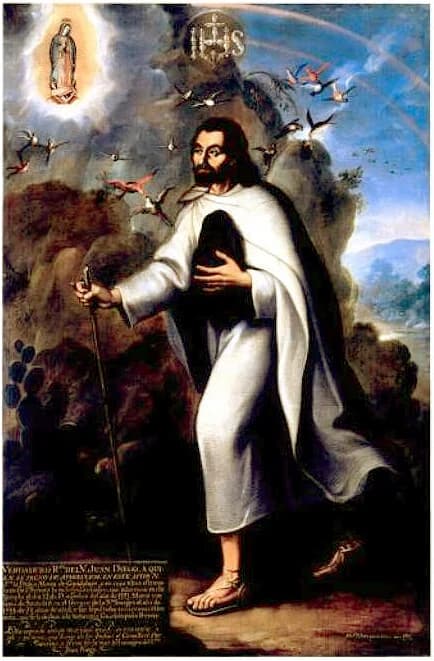
Juan Diego was an Indigenous Mexican Christian whose memory is inseparable from Our Lady of Guadalupe. According to the received Guadalupe narrative, he encountered Mary at Tepeyac in December 1531 and carried her request for a shrine to Bishop Juan de Zumárraga. The narrative recounts flowers gathered out of season and an image appearing on his tilma as the confirming sign.
The received account places him among adult Indigenous converts in the years after the arrival of Franciscan missionaries. It remembers his wife, María Lucía, as a fellow Christian and describes him as a widower by the period associated with the shrine. These details belong to the same traditional narrative as the apparitions.
These apparition details should be identified as Catholic devotional tradition rather than an independently documented modern biography. The same tradition remembers him living near the shrine and receiving pilgrims after his wife's death. John Paul II canonized him in Mexico City in 2002. His celebration particularly recognizes Indigenous participation in the history and life of the Church.
The story's significance includes the choice of an Indigenous messenger to address a colonial bishop. The shrine and image became central to Mexican Catholic devotion, but that later importance does not independently verify every biographical detail. Keeping tradition and documentary history distinct allows readers to understand both his veneration and the evidence's limits.
This saint is included on this recurring date in the U.S. Roman Rite calendar published by the USCCB. This reading guide gives U.S. calendar saints priority; the Mass celebrated on a particular year’s date can differ because of Sundays, seasons or higher-ranking celebrations.
Explore the biography & sources ↗