01 · Read · A life to discover
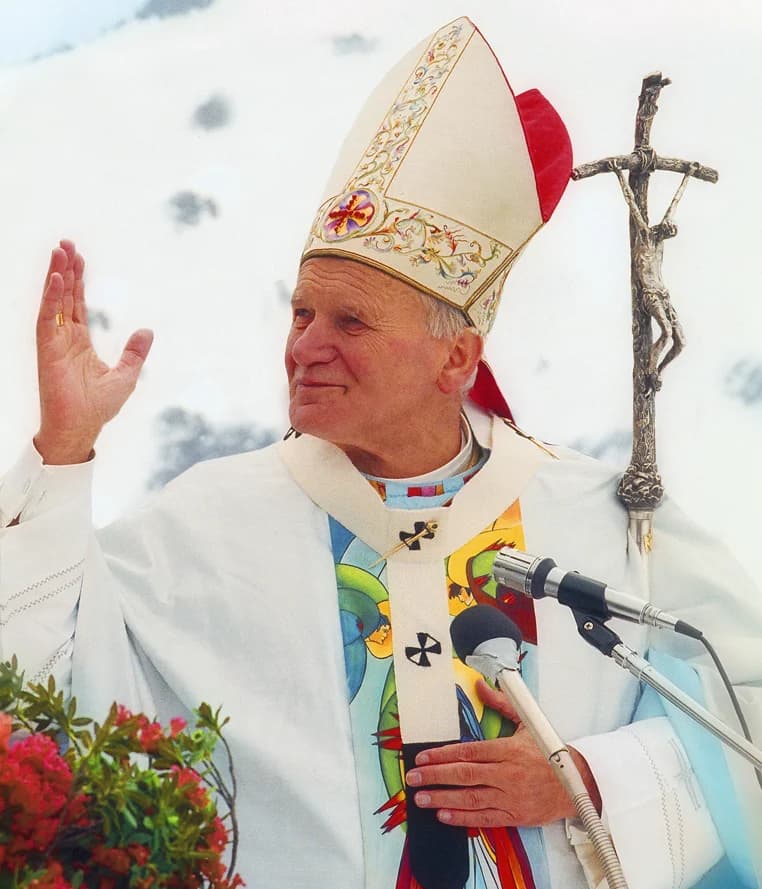
St. John Paul II
Karol Wojtyła grew up in Poland and pursued university studies and theater before the Nazi occupation interrupted his plans. He worked as a laborer and studied for the priesthood clandestinely. Later bishop and archbishop of Kraków, he participated in the Second Vatican Council before his election as pope in 1978.
Wartime work in a quarry and chemical factory supported him after the university was closed. His clandestine seminary formation took place alongside involvement in underground theater. Ordained in 1946, he continued studying in Rome and later taught ethics and theology, bringing philosophical training into his pastoral and episcopal responsibilities.
John Paul II's long pontificate included extensive international travel, the establishment of World Youth Day, major teaching documents, and the publication of the Catechism of the Catholic Church. He promoted dialogue with other Christians and religions while maintaining strong positions on Catholic doctrine. He died in 2005 and was canonized in 2014. His liturgical memorial marks his inaugural Mass rather than his death.
His election brought a Polish pastor shaped by occupation and communist rule to the papacy. Travel, encounters with young people, and sustained teaching became characteristic expressions of his ministry. The scale of his pontificate requires attention to particular events and documents rather than treating every development in the Church during those years as his personal achievement.
As a young priest he developed close relationships with students, accompanying them on outdoor trips as well as in worship and discussion. During his ministry in Krakow, the planned workers' district of Nowa Huta became a particularly significant setting: celebrating Christmas Mass there expressed the needs of a community denied a church building. Such experiences connected religious freedom with the everyday lives of families and workers.
An assassination attempt in Saint Peter's Square on May 13, 1981, seriously wounded him. After recovering, he visited the imprisoned attacker and offered forgiveness. In later years Parkinson's disease increasingly limited his movement and speech. His public ministry consequently included both the vigorous travel of his earlier pontificate and the visible limitations of serious illness, with his final years drawing attention to care for people who are frail or dependent.
This saint is included on this recurring date in the U.S. Roman Rite calendar published by the USCCB. This reading guide gives U.S. calendar saints priority; the Mass celebrated on a particular year’s date can differ because of Sundays, seasons or higher-ranking celebrations.
Explore the biography & sources ↗