01 · Read · A life to discover
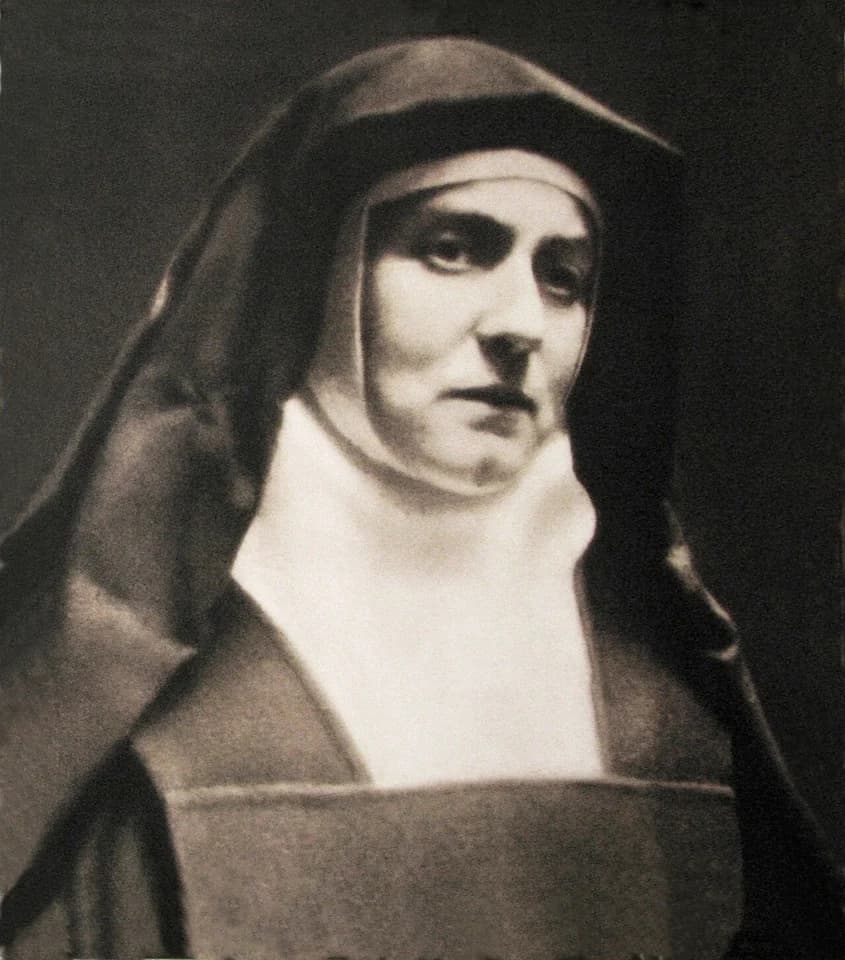
St. Teresa Benedicta of the Cross (Edith Stein)
Edith Stein was a Jewish-born philosopher who became a Catholic and a Discalced Carmelite. Known in religious life as Teresa Benedicta of the Cross, she was murdered at Auschwitz in 1942 during the Holocaust.
Born in Breslau in 1891, she pursued university study and became associated with Edmund Husserl's phenomenology, a philosophical approach concerned with human experience. Her intellectual work included the problem of empathy. During the First World War she also served as a nurse, encountering suffering outside the university.
Her religious searching eventually led to Catholic baptism in 1922. Before entering Carmel, she taught, translated, and wrote about education, philosophy, and women's participation in professional and religious life. Her vocation did not erase the Jewish family relationships that remained important to her.
Her autobiographical writing also preserved the texture of her Jewish upbringing. Life in a Jewish Family was intended to counter dehumanizing prejudice by making family relationships and ordinary experience visible. That project matters alongside her philosophical and religious works: she did not leave only abstract arguments, but a record of people threatened by racial hatred.
Nazi restrictions curtailed her public work. After entering the Cologne Carmel, she transferred to Echt in the Netherlands for safety. She and her sister Rosa were arrested in August 1942 and deported to Auschwitz. The commonly accepted date of her death is August 9. Reading Teresa of Avila's autobiography had been an important step in her conversion, and entering the order Teresa reformed gave that influence a lasting institutional form. Her transfer to the Netherlands could not protect her once Nazi occupation extended the danger across the border.
Canonized in 1998 and named a co-patron of Europe in 1999, Stein is remembered as both a serious intellectual and a victim of antisemitic persecution. Her Christian identity and the Nazi policy of persecuting people of Jewish ancestry must both remain visible in telling her story.
This saint is included on this recurring date in the U.S. Roman Rite calendar published by the USCCB. This reading guide gives U.S. calendar saints priority; the Mass celebrated on a particular year’s date can differ because of Sundays, seasons or higher-ranking celebrations.
Explore the biography & sources ↗