01 · Read · A life to discover
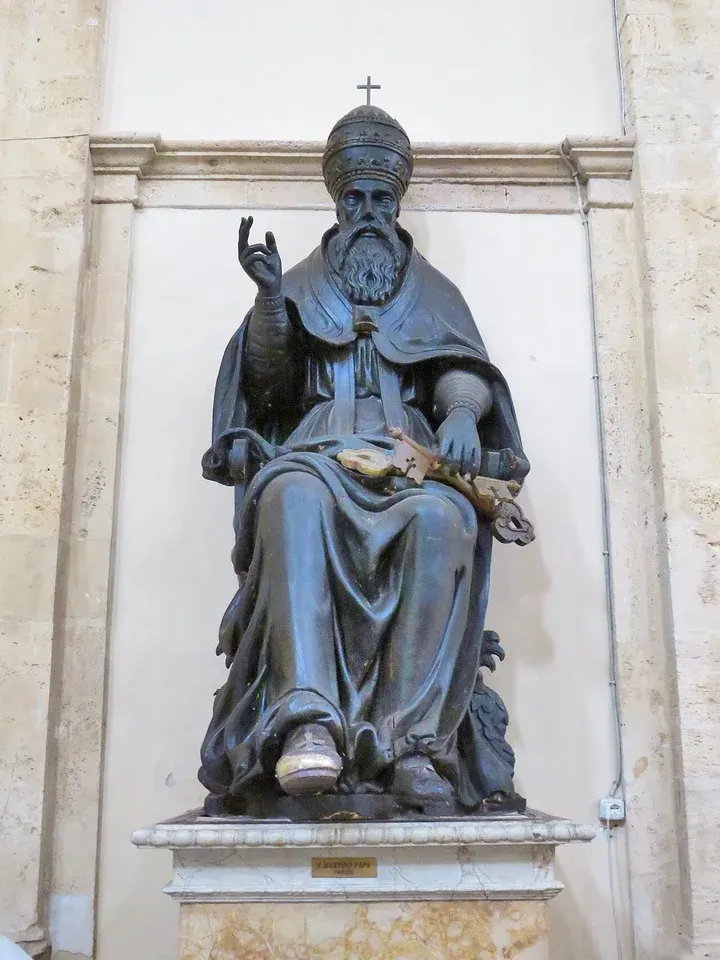
St. Martin I
Martin I became pope in 649 during a major controversy about Christ's human and divine wills. He convened a Lateran council that opposed Monothelitism and rejected imperial attempts to silence the debate. His defense of church teaching brought him into conflict with Emperor Constans II.
The theological question concerned whether Christ's genuine humanity included a human will, not merely a human appearance. Imperial efforts to suppress discussion sought religious stability, while Martin and the Lateran council judged silence inadequate. A doctrinal disagreement thus became a struggle over the limits of imperial control of church teaching.
Imperial officials arrested him in Rome and took him to Constantinople, where he suffered imprisonment and trial. He was ultimately exiled to Cherson in Crimea and died there in 655. Surviving letters convey the deprivation and isolation of his final period. The Church honors him as a martyr for the suffering and death resulting from his witness; his current Roman memorial is April 13.
His surviving correspondence makes the final exile unusually personal: it preserves need and isolation rather than only the formal record of a council. Cherson was far from the Roman community he had governed. His martyr title recognizes the consequences of persecution even though his death came through prolonged deprivation rather than immediate execution.
This saint is included on this recurring date in the U.S. Roman Rite calendar published by the USCCB. This reading guide gives U.S. calendar saints priority; the Mass celebrated on a particular year’s date can differ because of Sundays, seasons or higher-ranking celebrations.
Explore the biography & sources ↗